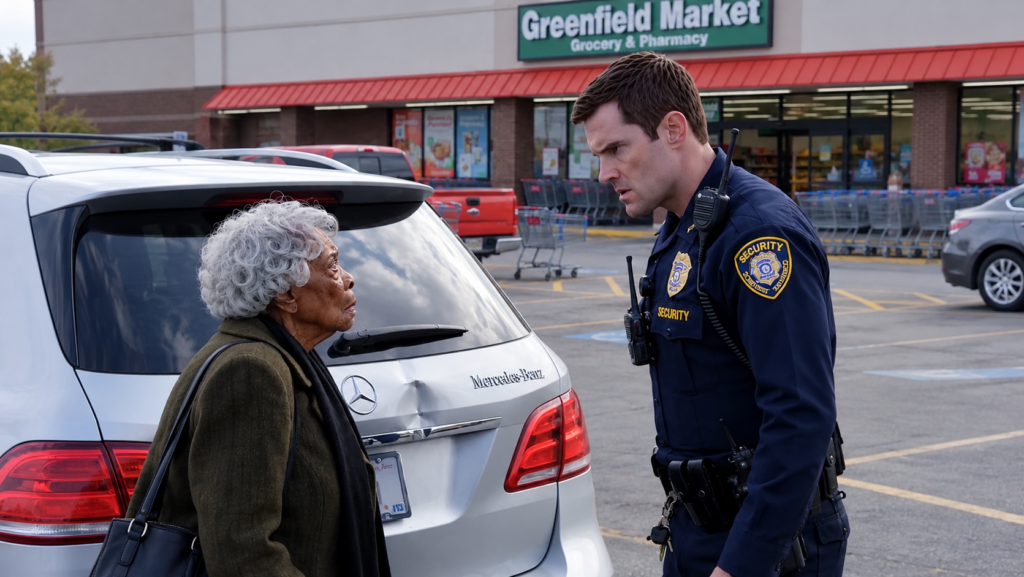
Gloria Holloway knew she had been driving too long when the scar beneath her blouse began to ache.
The surgeon had told her to take short trips for another week, and Greenfield Market was supposed to be a short trip.
She needed bread, bananas, and the kind of peppermint tea her granddaughter claimed tasted like toothpaste.
She parked her silver Mercedes near the entrance, left her cane beside the passenger seat, and checked the time.
Her discharge appointment had ended forty minutes earlier.
The hospital band was still around her wrist because she had forgotten to cut it off.
She sat for a moment,
breathing until the ache settled.
Then she opened her door and carefully stepped into the afternoon sunshine.
An officer was walking toward her from the far side of the parking lot.
He was young enough to be her grandson, with a rigid jaw and one hand resting near his belt.
“Step away from the vehicle and put your hands on the hood,” he said.
Gloria glanced behind her, expecting to see somebody running.
“Are you talking to me?”
“Hands on the hood, ma’am.”
“This is my car,” Gloria said.
“My registration is in my purse.”
“Keep your hands where I can see them.
”
She held up her keys, the silver star on the fob catching the light.
“Officer, I’ve just come from the hospital.”
“Do not reach inside the vehicle.”
“I wasn’t going to.”
He moved closer and repeated the instruction with more volume.
Several people turned to watch.
Gloria placed one palm on the warm hood and kept the other raised because bending forward pulled at her chest.
The officer looked at her differently now, as though her difficulty obeying proved something.
“Both hands,” he said.
“I can’t lean that way. I had heart surgery.”
“Do it now.”
She shifted her weight and felt a sharp tug beneath her ribs.
Her keys slid from her fingers onto the pavement.
“I have documents,” she said again.
“We’ll get to that.”
He took her right arm behind her back.
She gasped before the cuff clicked shut.
“Please don’t pull that shoulder,” she whispered.
He secured the other wrist while she protested, then guided her toward the rear of the car.
Her purse spilled when the strap caught on his elbow.
A medication bottle rolled beneath the Mercedes.
A folded registration slipped free and landed beside her shoe.
The officer did not bend to read it.
Across the lot, a cashier wearing a green apron stepped out through the automatic doors.
“Officer, she’s here every Thursday,” the cashier called.
“Please go back inside,” the officer answered.
“Her name is Gloria.”
“Ma’am, stand back.”
Gloria stared at the registration on the concrete and realized the officer had already decided what kind of person she was.
“Am I under arrest?” she asked.
“You’re being detained while I investigate a stolen vehicle report.”
“Who said my car was stolen?”
“Dispatch received a report.”
“Did dispatch give you the license plate?”
“I’m asking the questions.”
The sentence landed harder than the cuffs.
She had spent thirty-seven years teaching children to ask questions before making accusations.
Now she was struggling to draw a comfortable breath while someone treated the request for a basic fact as defiance.
A teenager stood near the shopping carts with his phone pointed toward them.
A woman beside a blue minivan began recording too.
Gloria felt sweat gather at her hairline.
“I need to call my son,” she said.
“You can do that later.”
“I need him now.”
The officer opened the rear door of his patrol car.
Gloria looked at the narrow seat and the angle required to enter it.
“I cannot sit like that without help,” she said.
“We’re not negotiating.
”
The cashier hurried closer despite the warning.
“Her pills are on the ground.”
The officer stepped between them.
“Move back.”
Gloria’s knees trembled.
Somebody in the gathering crowd said that the woman looked sick.
Somebody else said the officer was only doing his job.
A child asked why the grandmother was wearing handcuffs.
None of them answered.
CHAPTER TWO: THE MAN WHO SAID MOM
Officer Travis Boyd had been on the county force eleven months.
He had performed three vehicle stops that week, and his supervisor had complimented him for being decisive during two of them.
When the dispatcher relayed a report of a possible car theft at Greenfield Market,
he had asked one question.
“Any weapon information?”
The reply had come after a short burst of static.
“Caller says the subject might be armed.”
Boyd had pictured a suspect long before he reached the market.
He would later struggle to explain why the sight of an older woman holding a key fob had not changed that picture.
His partner, Officer Elena Price, arrived in the second patrol car just as Gloria asked again for her medication.
Price looked at the hospital band on Gloria’s wrist.
“What’s going on?” she asked.
“Possible vehicle theft,” Boyd said.
“Caller says she may have a weapon.
”
Price examined the Mercedes, the keys, and the scattered contents of the purse.
“Have you checked the plate?”
“I’m controlling the scene first.”
“Travis, she’s cuffed.”
“I’m aware.”
Price crouched and collected the registration without touching the loose medication.
Gloria watched her read the name aloud.
“Gloria Holloway,” Price said.
“That’s me,” Gloria answered.
Boyd glanced at the paper.
“Ownership alone doesn’t settle everything.”
“Then what would?” Price asked.
His radio interrupted them.
A voice announced that a supervisor was responding.
Gloria managed to say her son’s telephone number before the pain made her stop.
Price stepped aside and placed the call.
She introduced herself, explained that Gloria had been detained, and stopped speaking when the man on the other end asked where they were.
Three minutes later, a dark county sedan came around the corner too fast for the parking lot.
A tall man in a charcoal jacket emerged before the engine fully settled.
Nathan Holloway passed the watching crowd with his eyes on Gloria.
“Mom,” he called.
Boyd straightened so sharply that his radio cord pulled tight.
Nathan was the county police chief, and Boyd had attended his welcome briefing six days earlier.
“Chief Holloway,” Boyd said.
Nathan did not answer him.
He went to Gloria and saw her wrists, her wet eyes, and the effort every breath required.
“Tell me where it hurts,” he said.
“My chest is tight.”
“I need an ambulance,” Nathan told Price.
“She’s recently had surgery.”
Price was already reaching for her radio.
Nathan turned to Boyd.
“Remove those cuffs unless you have a current, specific reason to keep them on.”
Boyd looked from the chief to Gloria.
“We received an armed-theft call.”
“Do you have evidence she stole this vehicle?”
Boyd opened his mouth and closed it again.
“The caller was concerned,” he said.
“That isn’t what I asked.
”
Price stepped forward with the registration.
“The registration matches her identification, Chief.”
“Remove the cuffs,” Nathan repeated.
Boyd unlocked them.
Gloria pulled her arms forward and held one injured wrist against her stomach.
The skin was torn in two narrow places.
Her cane still lay beneath the passenger seat, and her medication bottle remained under the car.
Nathan looked around at the raised phones.
He recognized the fury moving through him and forced himself not to use it as an instruction.
“Officer Price, request medical assistance and preserve your body-camera footage,” he said.
“Notify the duty commander that I’m recusing myself from decisions about this incident.
”
Boyd looked relieved for half a second.
Then Nathan said something that wiped the relief away.
“My mother is not entitled to better treatment because of my job.”
“Neither should anybody else have to wait for somebody with my job to arrive.”
Gloria pressed his hand.
“Nathan, look at me.”
He did.
“I want to go home,” she whispered.
“I know,” he said.
“But we’re going to get you checked first.”
The ambulance arrived through a crowd that had grown larger than either of them realized.
As the paramedics helped her onto the stretcher, Gloria pointed toward a young cashier standing by the entrance.
“Please get that girl’s name,” she told Nathan.
“She tried to help.”
The cashier gave a small, frightened nod.
Nathan wrote the name on the back of a receipt because his hands were shaking too badly to use his phone.
Her name was Tessa Alvarez.
CHAPTER THREE: A CALL WITHOUT A FACE
By evening, the video had spread beyond Greenfield County.
A clip of Nathan saying “Mom” had been replayed so often that Gloria could hear it through the hallway television at the hospital.
The clip ended before anybody asked who had called the police.
It ended before Price checked the registration.
It ended before the paramedics examined Gloria’s wrists.
Nathan watched one version with the sound off and wanted to throw his phone across the room.
Gloria watched it from her bed and asked him to turn it over.
“They’ve made you the story,” she said.
“They’re talking about the arrest.”
“They’re talking about the surprise that you are my son.”
She adjusted the pillow behind her and waited until he sat down.
“Who made the first call?”
“An anonymous person.”
“Nobody is anonymous to the person who answered the telephone.”
“The call is under review.”
Gloria looked at him carefully.
“Are you doing the review?”
“No.”
“Good.”
Nathan had announced his recusal within an hour of leaving the market.
An investigator from a neighboring county, Captain Simone Everett, had agreed to lead the administrative inquiry.
A separate county oversight office would examine the dispatch handling.
The department’s attorney had warned Nathan that appearances of interference could damage any eventual discipline.
He did not need the warning.
His mother had raised him to understand that power was most dangerous when it felt justified.
Still, doing nothing was harder than he had imagined.
“They’ll want to interview you,” he said.
“They can come when I can sit upright without hurting.”
“I’ll make sure they respect that.”
“Nathan.”
He stopped.
“You cannot make sure of everything.”
That night, Tessa called Gloria’s room after a hospital receptionist passed along a message.
The cashier sounded twenty-two at most.
“Mrs. Holloway, I’m sorry,” she said.
“You don’t owe me an apology.”
“I knew it was your car.”
“You told them so.”
“I should have shouted louder.”
“You were the only one who stepped forward.”
Tessa’s voice broke.
She explained that her manager had ordered her back inside and warned her not to give interviews while wearing the store uniform.
“He says we don’t get involved in police matters,” she said.
“Your manager didn’t see everything you saw,” Gloria answered.
“He says our insurance doesn’t cover it.”
Gloria almost laughed.
“Insurance certainly has a lot of opinions these days.”
She heard Tessa breathe a little easier.
“I know who called,” the cashier said suddenly.
Gloria shifted in bed.
“Tell the investigators.”
“I don’t know if I can prove it.”
“Tell them what you saw, not what you think you can prove.”
Tessa described a woman wearing a blue volunteer vest beside the outdoor cart return.
The woman had pointed at Gloria’s Mercedes while speaking into a telephone.
Tessa recognized the vest from a neighborhood safety group that had recently begun meeting in the market’s upstairs community room.
“Her name is Marianne Vale,” Tessa said.
“She has one of those clipboards.”
Gloria knew Marianne vaguely as a woman who organized petitions about traffic and parking.
“Did she talk to you?”
“She came into the store after the ambulance left.”
“What did she say?”
Tessa lowered her voice.
“She asked whether the police had found the gun.”
Gloria closed her eyes.
Boyd had mentioned an alleged weapon repeatedly.
Now the accusation seemed to have acquired a life of its own.
“Tell Captain Everett exactly that,” Gloria said.
“You don’t need to solve the case.”
After the call, Gloria looked at the bandage around her wrist.
The pain had begun to fade, but the embarrassment had not.
She remembered a woman at the market whispering that the officer probably had a reason.
She remembered the child asking why the grandmother was in handcuffs.
Most painfully, she remembered wondering whether another frightened person might believe the accusation simply because so many uniforms had gathered around her.
She had worked for years to teach her students that humiliation was not evidence of guilt.
Now she understood why a lesson could feel very different from inside it.











