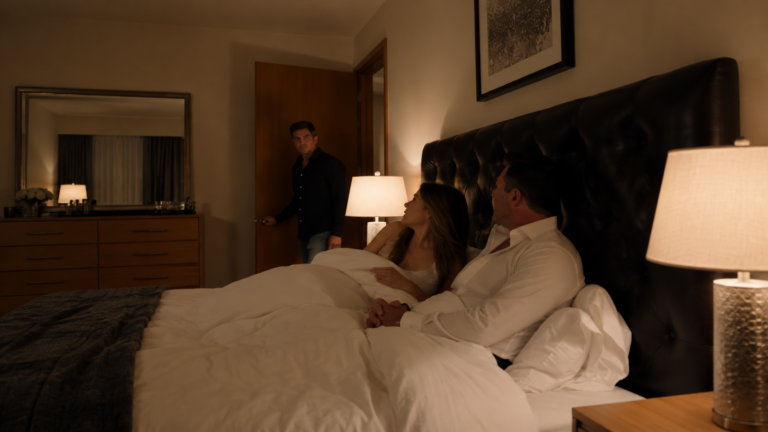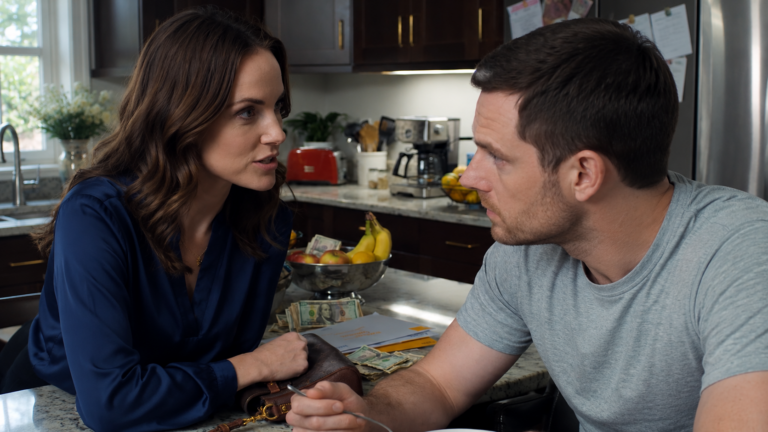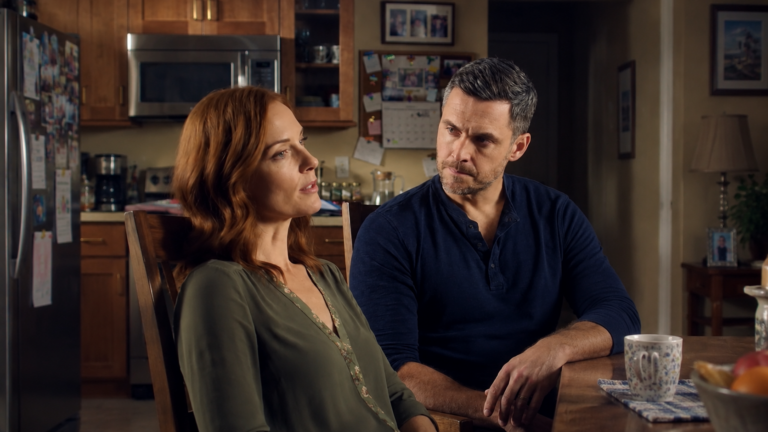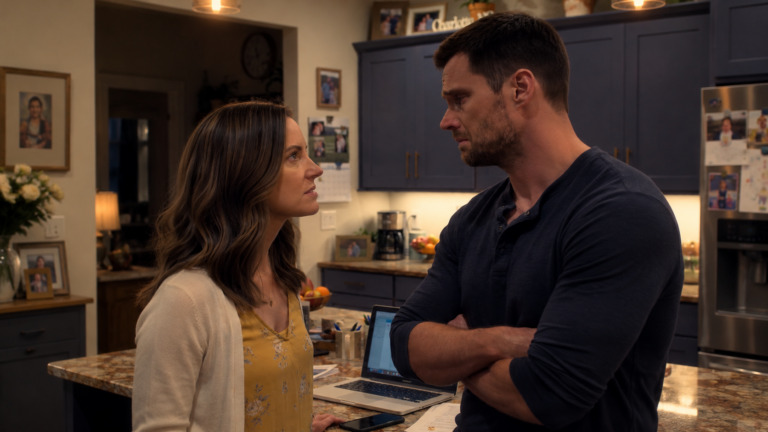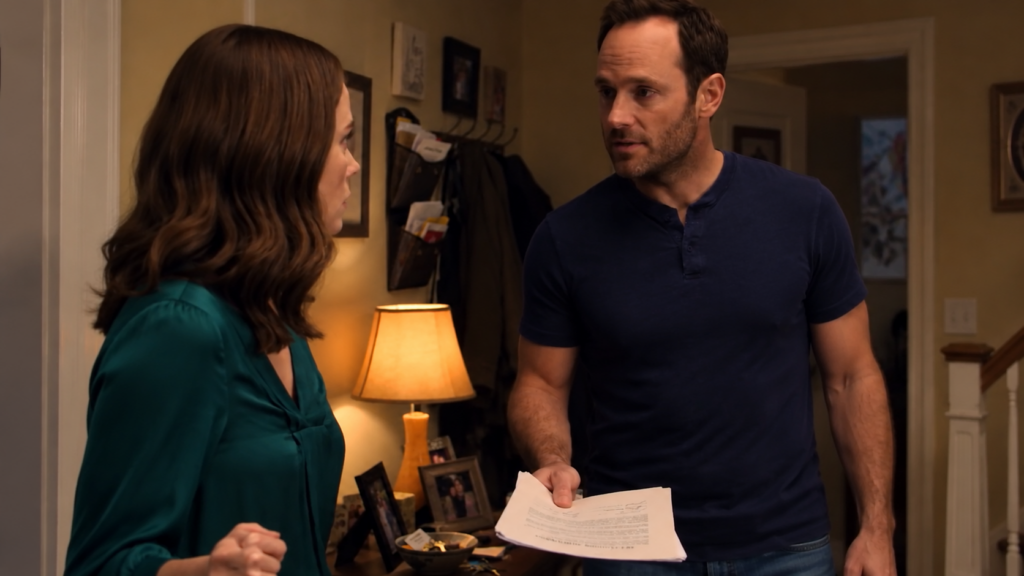
Lauren expected an argument when she announced she was going out with her ex.
Instead, her husband held out a separation agreement.
“Before you leave, sign this.”
Her hand froze on the doorknob. A drop of rain made a dark spot on the cuff of her gray coat. She had been rehearsing an entirely different confrontation during the twenty minutes she spent upstairs pretending to look for her earrings. She expected Owen to demand names, dates, explanations. She expected him to ask her to stay. A small, ugly part of her had wanted that, because then she could call his protest controlling and step through the door with a clean conscience.
“What exactly am I signing?”
“A separation agreement.”
The smile vanished. Owen laid the pages on the entryway table, beside the bowl containing loose change and the brass keys to their garage. He was wearing the green sweater she had given him three Christmases ago. That detail unsettled her more than his tone, which was so measured it sounded almost borrowed.
“For weeks,” he said, “you’ve hidden messages, turned your phone over at dinner, and told me you were meeting women from work. You decided tonight you could stop pretending. Fine. But you don’t get to keep me in the marriage while you find out whether you want somebody else.”
Lauren stared at the second page. Owen had already consulted a lawyer three days earlier. He had drafted temporary arrangements for the mortgage, their shared savings, and the small upstairs room where she kept her sewing machine. He hadn’t asked for a divorce yet. There was room for discussion. That should have softened the shock, but it didn’t.
“Three days?” she whispered. “You saw a lawyer three days ago?”
“You were in the shower. Your phone lit up on the counter. ‘Can’t wait to see you Friday. Same place?’ I didn’t go through anything. That one sentence was enough to tell me I needed advice.”
“You don’t know what that sentence means.”
“Then tell me.”
She should have. Later, Lauren would identify that moment as the last ordinary opportunity to speak honestly, before an unfamiliar woman’s name made the conversation impossible to simplify. She could have explained where she was going, why she had renewed contact with her former boyfriend, and what she had been saying to him about her marriage. The explanation would have been shameful, but at least it would have belonged to her.
Instead she said, “I told you I’m going out with someone I used to love. I’m not asking permission.”
“I know.” Owen moved a pen toward her. “I’m not giving or refusing it.”
Her phone buzzed inside her coat. The message came from Reid Mercer, the man she had dated at twenty-three, the man whose certainty once looked like courage and now looked, depending on the hour, like a way out. The text said: Don’t walk in through the front. Use the side entrance. I have a surprise.
For reasons she could not immediately name, Lauren’s throat tightened. Reid had said the same thing the night he opened a restaurant with borrowed money and made her wait in an alley while he checked whether his investors were seated. Back then she had found the secrecy romantic. Tonight it sounded like instructions.
Owen’s phone vibrated before she could answer.
He glanced at the unfamiliar number and read aloud, surprised: “Before your wife meets him tonight, there is something you need to know about her ex.”
A second message followed. “He told his wife he was working late.”
“His wife,” Owen repeated.
Lauren watched him lift his eyes.
“Who is it?” she asked.
“Megan.”
Her fingers tightened against the table. She had never met Megan Mercer, yet she knew the name. Reid said it frequently, sometimes with affection, more often with the exhausted theatrical patience of a man determined to sound misunderstood. Megan didn’t appreciate his sacrifices. Megan no longer believed in him. Megan had stopped listening long before he’d stopped talking. Those were the lines Lauren knew. What she didn’t know was that Megan had been listening carefully indeed.
“You didn’t ask who she is,” Owen observed.
“I know he has a wife.”
“You told me he was separated.”
“He said they were separating.”
“That is different.”
Lauren looked at the documents again. Every line she read seemed to have been written by someone who understood that leaving a room was easier than staying after the truth had arrived.
Owen’s phone lit once more. Megan had sent an address, a photograph of a restaurant’s dark side entrance, and one final sentence: Please don’t tell Reid I’m contacting you. I’m nearby, and I would rather explain in person than have him decide what you hear.
Outside, a car moved slowly through rain. Inside, the hallway clock clicked toward seven. Lauren’s date was scheduled for seven-thirty. She realized that whatever happened next, she wasn’t going to arrive at that appointment as the person who had spent the afternoon choosing earrings.
“Call her,” Lauren said.
Owen looked at his wife’s face, then pressed the number.
Chapter Two: The Woman at the Door
Megan’s voice was steady enough to sound rehearsed. She did not introduce herself as an injured wife, and she did not ask Owen to condemn Lauren. She asked whether the two of them were together and whether anyone else could hear the call.
“We’re in our house,” Owen said. “My wife is here.”
“Good. Keep the doors locked for the next ten minutes. I am not saying someone is coming to hurt you. I’m saying Reid has arranged for people to meet him tonight, and he has a habit of treating other people’s addresses as information he can share.”
Lauren stepped closer. “What people?”
Megan paused. “Lauren?”
“Yes.”
“I wish we’d met under less ridiculous circumstances.”
“What is happening at the restaurant?”
“That is exactly what I want us to discuss. But not over an open line if I can avoid it. I’m parked on the next street. I brought something I think you should see.”
Owen’s expression sharpened. “What kind of thing?”
“An invitation with my husband’s signature. Not a confession. Not a secret folder. Something he was planning to hand to a room full of people after you arrived.”
Lauren sat down on the bottom stair. For six weeks Reid had been drawing her back into a version of herself she had once abandoned: reckless, funny, convinced that bold action was proof of feeling. He called when she was tired. He remembered her favorite peach pie. He asked what she had wanted to become before she settled into a sensible life. He made Owen, who worked long shifts managing a municipal repair crew and could discuss roofing insulation for an hour, seem ordinary in the worst possible sense.
Yet she also remembered other things. Reid borrowing her car without asking. Reid telling a story with her standing right beside him and editing out every contribution she had made. Reid apologizing beautifully, then behaving the same way after the apology had worn off. She hadn’t forgotten those memories. She had chosen not to consult them.
Megan arrived eight minutes later in a yellow raincoat, with damp curls pinned away from her face. She was neither fragile nor grandly furious. She stood on their porch holding a grocery-store tote and asked whether she could take off her wet shoes. Owen led her to the kitchen. Lauren stayed by the counter while Megan set down a thick envelope, then took out a single heavy cream-colored card.
Across its front, in embossed black letters, were the words THE SECOND BEGINNING. Below them appeared the name of a private dining room and the time, eight o’clock. On the back, in smaller letters, was a description: An intimate evening exploring how a love story can be reclaimed after years of compromise. Special guests Reid Mercer and Lauren Ellis.
Lauren stared. Ellis was her maiden name. She had stopped using it at work after she married Owen.
“Special guests?” she said.
Megan nodded. “There are twenty-six reservations. Some have paid a substantial amount to hear a conversation between Reid and his first serious love. He calls it an honest dinner about courage.”
“I never agreed to be a guest.”
“I know that now.”
“What’s he selling?” Owen asked.
“An experience. Private dinners. Retreat weekends. Coaching sessions. A new business based on the idea that ordinary people can reinvent their lives by following their truest attachments.” Megan pushed the card across the table. “He told me the restaurant was hosting an investor tasting and he’d be overseeing service. He told Lauren tonight was a private conversation.”
Lauren’s stomach lurched. “He said we had a table in the back.”
“That part is technically true.” Megan’s voice remained even. “The back room has a table. It also has a stage, though he calls it a conversation platform because he doesn’t like the word stage.”
Owen let out a short breath that contained no laughter. “He was going to put my wife in front of an audience.”