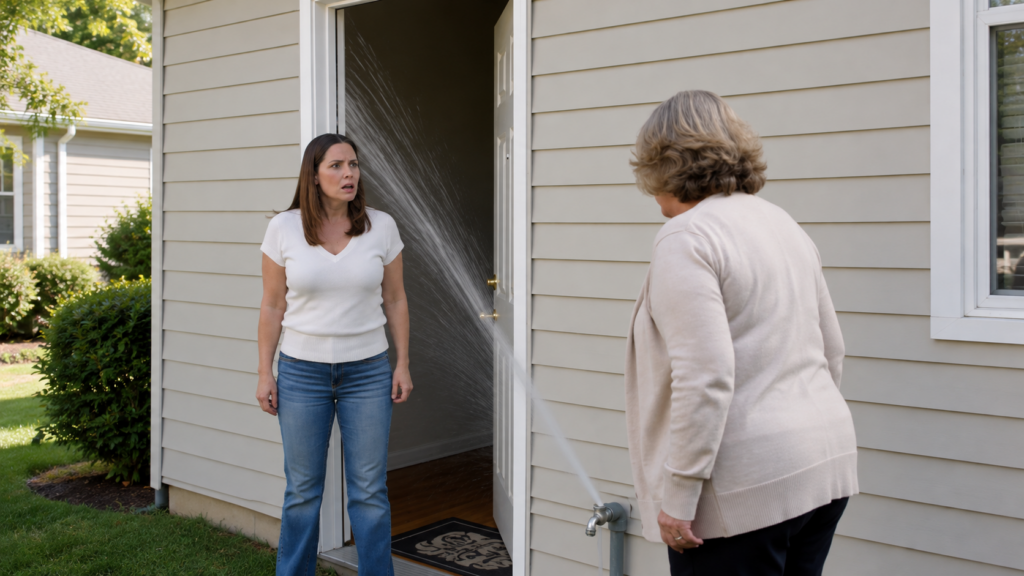
The first thing I heard was my daughter shouting that the kitchen floor was moving.
I thought she meant an animal had come through the back door.
Then I reached the hallway and saw a thin brown stream sliding over the wooden boards toward her bare feet.
Water was coming through the wall behind the sink, but the faucet was turned off.
My name is Lena Hart, and until that Thursday morning I believed our biggest problem was finding enough folding chairs for a meeting of exhausted women.
I was wrong about the size of our problem, although the folding chairs would eventually matter more than I could imagine.
My husband, Adrian, was already on his knees beneath the cabinet when I found the shutoff valve.
He closed it and listened to the angry noise inside the wall diminish to a miserable hiss.
Our daughter, seventeen-year-old Maisie, carried towels from the bathroom while our eight-year-old son, Finn, stood in the doorway clutching his school bag.
“Is the house going to fall down?” Finn asked.
“No,” Adrian said, although he was looking at the swelling plaster with considerable doubt.
The kitchen window faced the narrow path between our home and the house belonging to our neighbor, Vivian Price.
Vivian was standing beside her fence in a spotless cream-colored coat,
watching water run down our driveway.
She did not look surprised.
She looked irritated that we were still inside.
“You ought to get everybody out,” she called when I opened the window.
“The pipe is off,” I answered.
“Old houses are unpredictable,” Vivian said.
“You should cancel whatever gathering you planned for tonight.”
That was a strange thing to say before asking whether anyone was hurt.
I looked at the clock and remembered the eight women expected at our dining room table after six.
Three worked at a garment workshop downtown, two stitched clothing at home, and the others had been referred by an employment adviser named Celia Boone.
They were coming because I knew how to calculate wages, and several of them thought their pay had been quietly reduced without explanation.
I worked as an accounts assistant for a neighborhood clinic, not as an investigator.
But I could help someone compare a promised rate with the amount arriving in an envelope.
Vivian had learned about the meeting when Maisie mentioned our crowded evening plans over the fence.
I had not invited Vivian, although she often described herself as the most successful businesswoman on the street.
She owned an elegant clothing label called Vee Price Studio and had recently announced a presentation for buyers at the city’s annual Fashion Exchange.
“We’ll manage,” I said.
Vivian tightened her mouth.
“You have children in that house, Lena. Don’t be reckless just to prove a point.”
She disappeared inside before I could ask what point she thought I was proving.
Adrian emerged from the kitchen carrying a short length of copper tubing.
It was dark at one end and freshly scored at the other.
“This was behind the siding near the side gate,” he said.
“It hasn’t failed from age.”
He turned the pipe so that I could see the deep indentation in its surface.
“Somebody hit the outdoor supply run hard enough to split it.
”
I looked across the fence at Vivian’s immaculate windows.
For the first time that morning, I understood why she had known we would need to cancel.
CHAPTER TWO: A PERFECTLY REASONABLE ACCIDENT
The plumber arrived at nine with a white van and an expression that suggested he had already heard too many explanations from people who disliked their neighbors.
His name was Oscar Vidal, and he examined the exposed pipe without making a joke.
“Something struck this from the side,” he said.
“Can you tell what?” Adrian asked.
“Not from a mark alone, and I won’t guess for an insurance claim.
”
He photographed the break, checked the pressure, and pointed out a rectangular indentation beside the rupture.
“This section was installed eighteen months ago,” Adrian said.
“The fitting itself is sound.”
Oscar nodded.
“The fitting isn’t your problem.”
When Vivian came through the gate carrying a cardboard box of bottled water, she found the three of us beside the damaged line.
“Goodness,” she said.
“It looks terrible.”
I took the box because refusing drinking water would not repair a wall.
“Did you hear anything around the gate last night?” I asked.
“I sleep upstairs,” she replied.
“You know how difficult it is to hear anything from there.
”
Oscar shifted his flashlight toward the ground.
A pale flake of enamel was caught between two stones near the pipe.
Vivian’s gaze followed the beam, and she stepped backward so quickly that her heel struck a flowerpot.
“Perhaps somebody from the council damaged it,” she suggested.
“They’ve been digging all over the neighborhood.”
“The council hasn’t worked on our side path,” Adrian said.
“I’m only trying to help,” Vivian answered.
She looked at Oscar as though he might rescue her from our questions.
“How long before this house can safely hold visitors?”
“I’m repairing a damaged water line,” Oscar replied.
“I haven’t inspected the entire house.”
“I would imagine an evening meeting is out of the question.”
“That’s for the homeowners to decide,” he said.
Vivian left the water on our porch and walked away.
Oscar waited until her gate closed before asking whether there had been any disagreement about the path.
“No property disagreement,” I told him.
“The only argument we’ve had was about a group of women coming to dinner.”
He slid the broken pipe into a clean plastic sleeve.
“Keep this until you understand what happened,” he said.
“A damaged pipe can be replaced, but people become very inventive about explaining why it broke.
”
By noon we had water again, but half the kitchen wall had to dry before repairs could continue.
I moved the meeting into our garage and borrowed a heater from the neighbor opposite us, a retired bus mechanic named Harold Finch.
Harold helped Adrian carry out the folding chairs.
“Vivian said you were going to be evacuated,” he remarked.
“She said that before Oscar arrived,” I answered.
Harold paused with a chair against his hip.
“She told me around seven that your place would be unusable tonight.”
I felt the hairs rise along my arms.
“Our water didn’t start leaking until after seven.
”
“I know,” Harold said.
He looked toward Vivian’s house and lowered his voice.
“That’s why I remembered it.”
CHAPTER THREE: THE WOMEN IN THE GARAGE
At six fifteen, eight women entered our garage carrying grocery bags, notebooks, and the tired expressions of people who expected another disappointment.
I had set a kettle on a camping stove and covered a folding table with a clean sheet.
The first arrival was Rosa Medina, who had spent twelve years stitching formal dresses and could identify almost any seam by touch.
She handed me a brown envelope filled with handwritten time slips.
“My supervisor says the piece rate changed because the fabric is expensive,
” she said.
“Fabric costs don’t change the hours you already worked,” I replied.
Next came Hawa Diallo, who repaired embroidered coats at home after caring for her mother during the day.
She brought a sweater with a label that read VEE PRICE STUDIO in narrow gold letters.
“I made this,” Hawa said.
“Not merely repaired it.”
Vivian’s studio was preparing to sell that sweater for nearly six hundred dollars.
Hawa had received thirty-eight dollars for four evenings of work.
The others arranged their receipts and sample pieces across the table.
I recognized the frustration in their voices because my own mother had once cleaned hotel rooms for a contractor who never explained the deductions on her payslips.
Still, I had not expected their evidence to lead into the house next door.
“Vivian told me the people who sew her clothes earn excellent money,” Maisie said from the doorway.
Rosa laughed without amusement.
“She tells buyers those clothes are finished in her own studio by highly paid specialists.”
“Aren’t they?” Adrian asked.
“Some are,” Hawa replied.
“Most of us have never stepped inside that studio.”
A woman named Priya Shah placed a printed catalog beside her pay records.
The catalog advertised a limited collection called The Hands That Made Us.
Its introduction described Vivian as the designer who had personally restored nearly forgotten techniques of hand embroidery.
Hawa put her finger on a photograph of a coat.
“That sleeve is mine,” she said.
“My daughter drew the vine pattern for me before she left for university.”
“Could another person have made something similar?” I asked.
“Look beneath the fourth leaf,” Hawa said.
“I always bend the stem inward there because the thread must lie flat at the cuff.”
Rosa examined the picture and nodded.
“That’s her stitch.”
The garage went silent when we heard footsteps on the gravel.
Vivian stood in the doorway holding a paper plate of lemon biscuits.
“What a lovely little gathering,” she said.
No one reached for the plate.
Her eyes moved from the catalog to the envelopes.
“I hope you aren’t making promises you can’t keep, Lena.”
“We’re checking pay records,” I answered.
“That sounds rather legal for a kitchen-table conversation.”
“It’s only arithmetic and questions.”
Vivian turned to Hawa.
“You should have spoken to production if you had concerns.”
“I did,” Hawa said.
“Production stopped giving me work.”
For one second Vivian appeared to lose her practiced smile.
Then she placed the biscuits on the table and left without saying goodbye.
Maisie watched her cross the driveway.
“She didn’t come to see whether our pipes were fixed,” she said.
“She came to see whether the meeting happened.”











