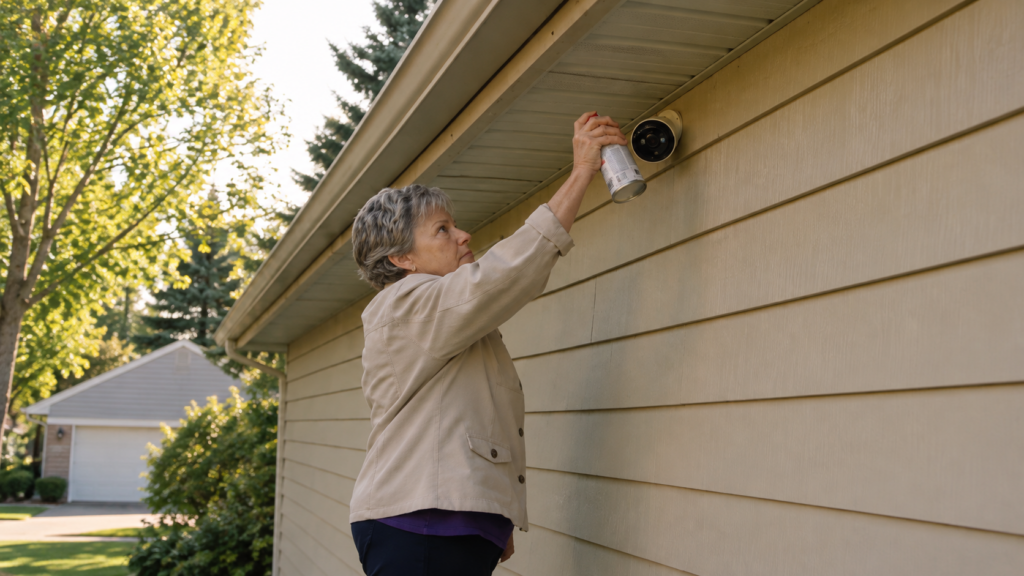
The first thing I heard was not the crash.
It was the sudden absence of the familiar click from the monitor beside my kitchen sink.
The little green light had been blinking every thirty seconds since I installed the camera over the side gate.
Now the screen showed a gray rectangle and the words CONNECTION LOST.
I set down my coffee and went outside.
My neighbor, Vera Lang, stood on a wooden stool beneath the eaves with a garden spade in her hands.
Fragments of my camera glittered around her shoes.
She was sixty-three, normally careful about her appearance, and wearing a blue raincoat over her nightdress.
She looked at me without surprise.
I asked her why she had destroyed my camera.
She said, ‘It was watching something it had no right to watch.’
The words made me colder than the October air.
My husband, Jonah, came through the back door with our nine-year-old daughter, Lily, behind him.
I told Lily to stay inside.
Vera climbed down from the stool, still holding the spade.
Jonah stepped between her and the doorway.
‘Put that down,’ he said.
Vera lowered the blade to the ground.
She pointed toward the narrow alley that separated our garage from the vacant brick schoolhouse at the back of the block.
‘Your camera looks straight into that passage,’ she said.
‘It looks at my gate,’ I answered.
‘And everything beyond it.’
I glanced toward the schoolhouse.
The rear doors had been chained for years, but last week I had seen work lights inside.
I assumed contractors were inspecting the building before the city sold it.
Vera seemed to know what I was thinking.
‘People have a right to be unseen,’ she said.
‘Not while they’re smashing somebody else’s property,’ Jonah replied.
I took out my phone and photographed the camera housing, the stool, the spade, and the marks she had left on the siding.
Vera watched every movement.
I asked whether she intended to pay for a replacement.
She answered that she would, provided I did not install another lens facing the alley.
That was when I noticed the orange tape tied around her wrist.
It looked like the wristbands used at concerts or public events.
A black number had been written on it in thick marker.
The number was seventeen.
Vera tucked her hand into her raincoat pocket when she noticed my glance.
‘What happened back there?’ I asked.
‘Nothing that concerns your family.’
Then a vehicle engine started behind the schoolhouse.
Someone shouted a name.
Vera turned so sharply that her stool fell over.
The voice shouted again, and I heard the unmistakable terror beneath the words.
‘We cannot find Martin.’
Vera ran toward the alley.
Jonah and I exchanged one look and followed her.
CHAPTER TWO: THE MAN WHO DID NOT COME BACK
The alley was barely wide enough for a delivery van.
Wet maple leaves had gathered against the schoolhouse wall, and a temporary floodlight washed the pavement white.
A gray minibus stood outside the rear entrance with its doors open.
Six people wearing orange wristbands crowded around a young woman holding a clipboard.
Two were elderly.
One had a walking cane.
The youngest looked no older than seventeen.
Vera reached the group before us.
‘What do you mean you can’t find him?’ she demanded.
The woman with the clipboard said Martin had not returned from the lower corridor.
I asked whether someone had called emergency services.
Nobody answered.
A man in a reflective vest stepped in front of me.
‘We’re conducting a controlled exercise,’ he said.
‘An exercise with a missing participant?’ I asked.
He introduced himself as Graham Pike, field coordinator for the Civic Preparedness Initiative.
He said the group was rehearsing an emergency relocation scenario for an upcoming community presentation.
I asked whether the fire department knew the building was occupied.
He said a supervisor had approved the session.
That was not the question.
The teenager stepped forward.
‘Martin went down the stairs after the smoke machine started,’ he said.
Graham shot him a hard look.
‘Please stop improvising, Owen.’
Owen went quiet.
Jonah was already dialing emergency services.
Graham told him that involving official responders would disrupt the exercise.
Jonah kept speaking into the phone.
I followed the teenager’s gaze to the open door.
A faint gray haze drifted from the corridor, carrying the chemical smell of theatrical fog.
I asked Owen how long Martin had been missing.
He looked at the clipboard woman.
‘At least twenty minutes,’ he said.
Vera gripped the orange band around her wrist.
Graham announced that everyone should return to the bus.
Nobody moved.
‘If somebody’s inside, we’re not leaving,’ said the woman with the cane.
A fire engine siren sounded in the distance.
Graham walked quickly to the minibus and made a call.
I heard him say, ‘The neighbors have interfered, and the recording issue is handled.’
The recording issue.
I looked at Vera.
She had heard him too.
She suddenly seemed older than she had in our yard.
‘You smashed my camera for him,’ I said.
Her eyes filled with something I could not yet call regret.
‘I smashed it because of what would have been on it,’ she answered.
The fire engine turned into the street as Graham hurried toward his car.
A firefighter stepped into the alley and ordered everyone back.
Graham opened his car door, but a police officer who had arrived behind the fire engine asked him to remain.
For the first time that morning, Graham stopped giving orders.
CHAPTER THREE: AN EMPTY SCHOOLHOUSE
Firefighters entered the building with breathing equipment and portable lights.
An ambulance crew assembled a stretcher beside the bus.
The man in the reflective vest tried to explain that the fog was harmless stage vapor.
The captain told him that a locked building with unverified exits was not a harmless stage.
I stood beside Jonah and watched the rescue crew disappear through the doorway.
Lily was still inside our house, and I asked Jonah to check on her.
He hesitated because he did not want to leave me alone with Vera.
I reminded him that our daughter had already seen enough.
He went home through our side gate.
Vera crouched on the curb with her hands pressed together.
The woman with the cane sat beside her.
Her name was Dolores Finch, and she told me she had been invited to rehearse for a county evacuation demonstration.
She was seventy-four and had difficulty walking long distances.
She believed the organizers needed volunteers to show how people with limited mobility could be helped during emergencies.
‘Were you paid?’ I asked.
Dolores shook her head.
‘They promised transportation and lunch.’
The clipboard woman approached us.
She said her name was Tessa Ward and that she was an administrative assistant, not a safety professional.
Her voice trembled.
‘Martin was meant to play a patient who needed help getting downstairs,
’ she said.
‘Why was he alone?’ I asked.
Tessa looked toward Graham.
‘He wasn’t supposed to be.’
A firefighter emerged from the doorway carrying a dark equipment bag.
Another followed with Martin, a gray-haired man supported beneath both arms.
Martin’s trousers were dusty and his face was streaked with sweat.
He was conscious but struggling to breathe.
The ambulance crew put an oxygen mask over his nose and mouth.
Dolores stood despite the pain in her knees.
Martin lifted one shaking hand toward her.
An emergency medical technician asked whether he had fallen.
Martin managed to say that the service door had closed behind him.
He had searched for another exit and found every corridor locked.
The firefighter confirmed that they had forced open two doors before reaching him.
Graham said the locks were part of the scenario.
The captain turned toward him.
‘You do not lock real people into a building to simulate being trapped,’ she said.
Nobody spoke for several seconds.
Then Martin grabbed the medic’s sleeve.
‘Where’s the woman with the red scarf?’ he whispered.
Tessa dropped her clipboard.
Graham’s expression changed.
I had not seen anyone wearing a red scarf.
The captain asked Martin whom he meant.
He tried to answer, coughed, and was moved toward the ambulance.
I watched Graham quietly step backward toward the police officer.
The officer told him to stay where he was.
Vera stared at the schoolhouse doors.
She whispered, ‘I told them they weren’t ready.’
CHAPTER FOUR: THE REASON FOR THE CAMERA
The police took initial statements on the sidewalk.
An officer asked whether I had video of the alley before my camera was destroyed.
I explained that it recorded only when motion crossed the gate line and stored clips locally for a limited period.
I had installed it after two bicycles were stolen from our driveway.
I showed the officer the broken mount and the photographs of Vera holding the spade.
He wrote down her name and address.
Vera did not deny breaking the camera.
She told him she would replace it and accept responsibility.
When he asked why, she looked at Graham and said she would answer after speaking with counsel.
That was a different woman from the one who had shouted at me in my yard.
The police asked the volunteers to leave their contact information before going home.
Several had no idea which organization had recruited them.
Dolores said a flyer had come through her senior center.
Owen said a teacher had recommended the experience as volunteer hours.
One man believed he was attending training for a neighborhood watch program.
The explanations did not match.
Tessa was packing materials into the minibus when I asked about the woman in the red scarf.
She stopped moving.
‘I don’t know,’ she said too quickly.
A crumpled sheet slid out of her clipboard and landed near my shoes.
The sheet showed a plan of the schoolhouse.
A blue line marked a route through the first floor.
A red line ended at a basement door.
Beside the red line someone had written the initials M.F.
I passed the sheet back to Tessa without photographing it.
‘If that route mattered, please give it to the firefighters,’ I said.
She swallowed and walked toward the captain.
I went home before noon.
Jonah had made scrambled eggs for Lily, who was asking why the police had come to our street.
We told her that people had been practicing something dangerous in the old school and that the adults were sorting it out.
We did not tell her that a man had nearly suffocated within fifty yards of her bedroom.
That afternoon a replacement camera installer inspected the ruined wiring.
He said someone had removed the memory card before smashing the shell.
I looked again at the photographs on my phone.
Vera had struck the casing hard enough to crack its lens, but I could see a neat empty slot underneath.
She had not merely wanted the camera turned away.
She had wanted the stored footage.
I called the officer handling the report and told him what the installer had found.
Then I walked across the street and knocked on Vera’s door.
She opened it with the chain still fastened.
I asked where my memory card was.
She looked over her shoulder before answering.
‘Inside,’ she whispered.
‘Who else is there?’ I asked.
Vera closed the door without replying.











