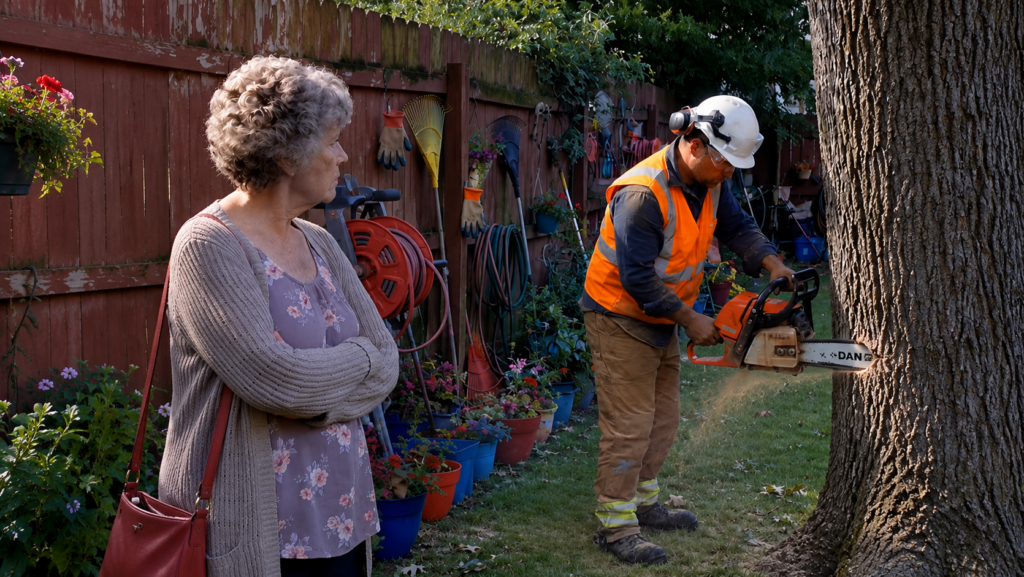
The chainsaw stopped before Daniel Reed reached the gate.
That was the first thing he remembered afterward.
Not the sound of the engine, or the shouting, or the cloud of sawdust drifting over the fence.
It was the sudden absence of the leaves that had always moved above his kitchen window.
A man wearing orange hearing protectors stood beside a fresh oak stump.
Two others were feeding branches into a chipper parked on the street.
Carol Mercer stood near the fence with her arms folded, watching them work.
Daniel pushed through the gate so hard that the latch struck the post.
“What are you doing on my property?”
The man with the chainsaw turned off the motor completely.
Carol looked almost pleased to have an audience.
“That tree was a danger to my house,” she said.
Daniel stared at the stump.
Twenty years earlier, his father had planted a folding chair beneath that tree and taught him how to repair a bicycle chain.
His daughter had learned the names of birds by watching them nest in its branches.
The chair was still in the garage.
The tree was gone.
“Who hired you?” Daniel asked the contractor.
The man removed his hearing protectors.
“Mrs. Mercer signed the work order,” he said.
“On whose property?”
“She told me the tree was hers.”
Daniel turned back to Carol.
“You signed this last month.”
He raised the blue folder he had grabbed from the kitchen table when he heard the saw.
Carol glanced at it, and the pleased look disappeared.
Inside was the survey she had submitted during a property dispute.
It clearly marked the oak several feet inside Daniel’s boundary.
Her signature appeared beside an acknowledgment of the same line.
Daniel opened the folder to the second page.
A narrow strip of land ran between the oak and Carol’s detached garage.
Carol had spent months insisting that strip belonged to her.
The survey she had submitted said otherwise.
The contractor leaned closer without touching the pages.
“You told me this was your yard,” he said.
Carol lifted her chin.
“The survey is being challenged.”
“Not by you last month,” Daniel said.
“You signed it.”
“People sign things without understanding every implication.”
“Did you understand that you were ordering a crew onto my property?”
The contractor looked toward his workers.
“Shut down the chipper,” he called.
The machine fell silent.
Without the noise, Daniel heard something he had missed before.
A heavy vehicle was approaching from the far end of the street.
Carol looked at her watch.
“You’re making this much more complicated than it needs to be,” she said.
A flatbed truck rounded the corner, followed by a vehicle with a flashing amber beacon.
The flatbed carried something enormous beneath a blue protective cover.
Daniel could see the outline of a rectangular structure taller than the truck’s cab.
The driver slowed as he spotted the tree crew.
Carol raised one hand to wave him forward.
Daniel stepped between her and the driveway.
“Who are they?”
Carol did not answer.
The contractor stared at the flatbed.
“Mrs. Mercer,” he said, “you told us to clear a dead tree for routine maintenance.”
“It was necessary maintenance.”
“Then why is a transport convoy arriving?”
Carol’s voice sharpened.
“Because I have a delivery scheduled.”
Daniel looked at the narrow strip of grass that the tree had shaded.
Fresh tire tracks already crossed it.
A line of yellow paint had been sprayed over his lawn.
He suddenly understood that the oak had been removed for something other than sunlight or safety.
The flatbed driver sounded his horn once.
Carol started toward him.
Daniel moved to the gate first.
“Nobody brings that thing through here,” he said.
Carol turned, her face hard.
“If they don’t deliver it today,
you’ll regret what you’ve done.”
Daniel looked at the sawdust covering his father’s old chair beneath the garage window.
Then he looked at the contract crew gathering around the arriving truck.
“That’s a strange thing to say,” he answered, “when you just destroyed my tree.”
CHAPTER TWO: THE THING UNDER THE BLUE COVER
The driver introduced himself as Luis Ortega.
He was a broad-shouldered man with a careful voice and a laminated route sheet clipped to his vest.
Before he stepped down from the cab, he asked everyone to stand clear of the wheels.
Carol tried to wave him toward her driveway.
Luis ignored the gesture.
“Who is the legal receiving party?” he asked.
“I am,” Carol said.
“And who’s responsible for that side clearance?”
“I am.”
Daniel raised the survey.
“I’m the owner of the land she’s pointing at.”
Luis studied him for a moment.
Then he looked at the painted line crossing Daniel’s grass.
“That’s new information.”
Carol stepped forward.
“He’s a difficult neighbor who’s decided to disrupt a lawful installation.”
“You can discuss that with your lawyer,” Daniel said.
“You don’t get to tell a truck to cross my yard.”
Luis unfolded the route sheet.
A penciled drawing showed a path from the street,
past Carol’s garage, through the narrow strip, and onto a concrete foundation behind her house.
Daniel saw his oak represented by a small circle crossed out in red.
Beside it were the words CLEAR BEFORE ARRIVAL.
Luis pointed at the notation.
“Was the removal permission verified?”
Carol opened her mouth.
The tree contractor answered first.
“We were shown a property sketch, not a permit or the signed survey he’s holding.”
Luis exhaled slowly.
“Then we have an access dispute.”
Carol’s phone rang.
She looked at the screen and declined the call.
“Just unload it onto my driveway until we resolve this,”
she said.
“It’s sixteen feet wide and thirty-two feet long,” Luis replied.
“It doesn’t fit in your driveway.”
“Then put it on the street.”
“That would block emergency access, and the city hasn’t issued a street occupancy permit for storage.”
Daniel stepped around the truck to see its cargo.
The edge of the cover had lifted in the wind.
Underneath sat a tall, factory-built structure with pale siding, three windows, and a dark green door.
An entire small building rested on the flatbed.
At its rear stood a circular steel platform with a handrail.
“What is that?” Daniel asked.
Carol answered too quickly.
“A garden studio.”
Luis glanced at his paperwork.
“An assembled modular classroom,” he corrected.
Daniel looked back at Carol.
“A classroom?”
“It’s my property,” she said.
“That’s all you need to know.”
Luis lowered his voice.
“The carrier’s manifest describes it as a demonstration unit for an after-school arts program.”
Carol’s face colored.
“Can we please stop discussing my personal business on the sidewalk?”
A woman emerged from the passenger seat of the escort vehicle.
She wore a cream blazer and carried a hard-sided equipment case.
Her name tag read TESSA VALE, NORTHPOINT LEARNING.
“Why aren’t we moving?” she asked.
Carol hurried toward her.
“We’ve encountered a very temporary misunderstanding.”
Tessa looked at the stump, the survey, and the open gate.
“I was promised a completed access corridor.”
“It is completed,” Carol insisted.
“The neighbor is interfering.”
“Then why are your contractors standing around?”
Luis handed Tessa the route sheet.
“Because the corridor appears to belong to the neighbor.”
Tessa studied the drawing.
She looked up at Carol with the expression of someone watching a carefully timed plan begin to collapse.
“Tell me you have something in writing,” she said.
Carol glanced at Daniel’s folder.
Daniel held it tighter.
“I have something in writing,”
he said.
“And it says this is my yard.”
CHAPTER THREE: THE CLASSROOM THAT WASN’T SUPPOSED TO BE HERE
By noon, six vehicles had gathered along the street.
The tree contractor was photographing the stump for his insurance company.
Luis was calling his dispatcher.
Tessa had retreated to her vehicle and was speaking into a headset.
Carol stood between her garage and the flatbed, making calls she ended whenever anyone approached.
Daniel sat on his front steps and tried to steady his hands.
His friend Priya Shah arrived after he texted her a photograph of the stump.
Priya was a civil engineer who lived two streets away, but Daniel had called her as a friend rather than as a professional.
She approached the stump without speaking.
Then she placed her palm on the freshly cut wood.
“How old?” she asked.
“Twenty years in our family,” Daniel answered.
“The tree itself was older.”
“I’m sorry.”
Daniel nodded because he could not trust his voice.
Priya examined the disturbed soil beside the stump.
“Did they grind out the roots?”
“No.”
“Good.”
“Why is that good?”
“Because nothing else should be excavated until someone documents exactly what happened here.”
Carol crossed the grass before Daniel could answer.
“You can’t photograph my property without permission.”
Priya looked up.
“I’m standing on Daniel’s side.”
“You’re all enjoying this far too much.”
“I’m not enjoying any part of it,” Daniel said.
Carol pointed toward the flatbed.
“That building serves children.”
Daniel waited.
She seemed to expect the statement to end the argument.
“Whose children?” he asked.
“Families who need after-school space.”
“Where are they now?”
“That’s none of your concern.”
“Did you tell those families you could deliver a classroom through my yard?”
Carol looked away.
Tessa returned, carrying her equipment case.
“I need a private conversation with the receiving party,” she said.
Daniel began to step away, but Tessa stopped him.
“Actually, you should stay.”
Carol glared at her.
Tessa opened the case on Luis’s tailgate.
Inside was a tablet, a bundle of transport photographs, and a rolled site plan.
She displayed an overhead drawing of the neighborhood.
The modular building had been scheduled for placement on a pad behind Carol’s garage.
A shaded rectangle crossed the property line at exactly the place where Daniel’s oak had stood.
“The manufacturer approved the structure for this location based on the clearances described in this plan,” Tessa said.
“Who prepared it?” Daniel asked.
Tessa tapped the title block.
“Higgins Site Services.”
Carol flinched.
Daniel knew the name.
The company had sent him a letter in August offering to purchase a narrow easement along his fence.
He had declined.
Two weeks later, Carol had insisted that the strip had never been his at all.
“Who paid for this plan?” Daniel asked.
Carol folded her arms.
“I paid for professional advice.”
Tessa looked at the stamped title block.
“The drawing was marked preliminary.”
She turned another page.
“The final copy was supposed to include written approval from every affected owner.”
Daniel laughed once, without humor.
“Nobody asked me.”
Tessa looked directly at Carol.
“The route certification you gave us says consent was obtained.”
“It was a misunderstanding,” Carol said.
“You signed a statement,” Tessa replied.
Daniel felt the shape of the story change.
Carol had not simply invented a boundary because she disliked his tree.
She had sold someone a route that did not exist.
“What happens if that building doesn’t get delivered?” he asked.
Tessa shut the case.
“That’s going to be a much more serious conversation.”











