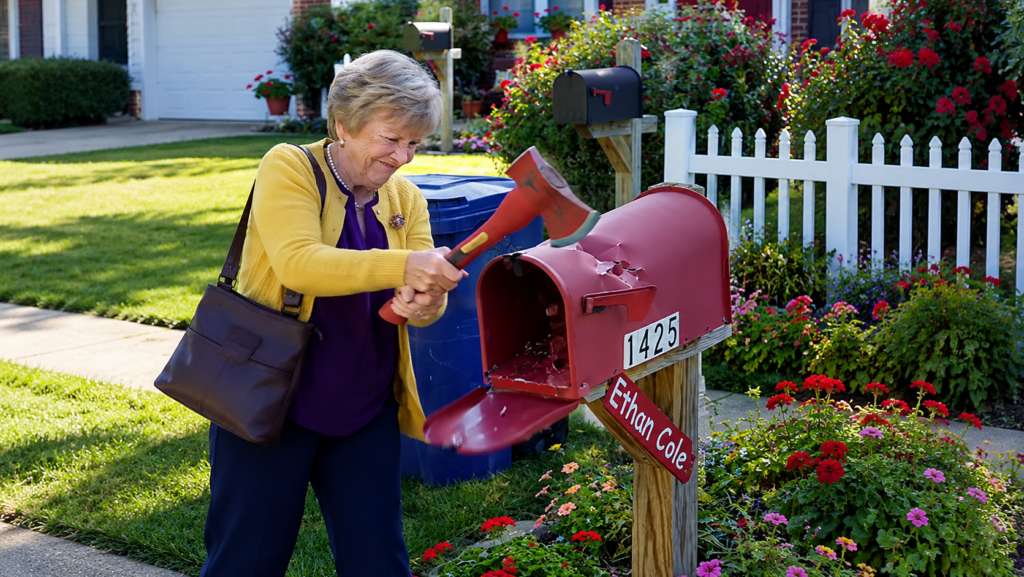
Ethan Cole noticed the tire tracks before he saw what remained of his mailbox.
The black steel post had been bent toward the street, and the box lay flattened against the curb like a tin can.
Fresh mud marked the grass where two wheels had climbed over the edge of his lawn.
He set down his grocery bags and walked toward the damage without taking his eyes off the driveway opposite his house.
Carol Mercer stood beneath her front awning, watching him with her arms folded.
She had been watching him almost every evening since the county announced its neighborhood walkway improvements.
Ethan lifted the crushed mailbox by its broken hinge.
The numbers were still there, except that the five had been bent into a crooked hook.
“What happened to my mailbox?” he called.
Carol shrugged.
“Maybe someone was tired of your deliveries.”
Ethan looked at the wide tires on her dark green utility cart.
Its front bumper bore a streak of black paint.
“You see somebody hit it?”
“I saw a lot of traffic today.”
“Then you won’t mind telling me what time.”
“I have better things to do than monitor your property.”
She said it while standing perfectly still, staring at his property.
Ethan photographed the broken post, the tracks, and the bumper across the street.
He resisted the temptation to cross the road and accuse her.
A photograph could show damage, but it could not prove who had been driving.
His father had spent his last months using a wheelchair after a stroke.
Ethan had widened the short walkway to the front door so two people could pass without turning sideways.
He had also lowered the porch threshold and installed a sloping section of concrete beside the steps.
Those changes had allowed his father to sit on the porch every morning and watch the neighborhood wake up.
After the funeral, Ethan kept the ramp.
Several neighbors had borrowed it when visiting with walkers, strollers, or injured legs.
Carol called it an eyesore.
Three weeks later, a county notice accused him of creating an unauthorized commercial entrance.
He had disproved that complaint with photographs of the original construction permit.
Another notice accused his friend Rosalie of obstructing a public walkway with a portable ramp.
A third accused an older couple of maintaining an illegal curb cut.
Each complaint arrived after Carol appeared near the property with her measuring stick.
Yet nobody could prove she had submitted them.
Ethan carried the ruined mailbox into his garage and called the local post office.
A clerk explained that he needed to make temporary arrangements for delivery and report the destruction.
Ethan did both.
At dusk, he dragged two orange cones beside the broken mounting and tied a reflective strip between them.
Across the street, Carol drove her cart into the garage and closed the door before he could see the bumper again.
That night, a message arrived from his friend Priya Shah, who lived near the bottom of Laurel Lane.
The county contractor had posted orange markings beside her mother’s wheelchair ramp.
The marks were accompanied by the words REMOVE BEFORE FRIDAY.
Ethan stared at the photograph until the screen dimmed.
Friday was only two days away.
He wrote back asking Priya not to touch the marks and promised to come by before work.
Then he opened a county map of the proposed accessible-route project.
The bright blue line ran along his street, turned past Carol’s house, and ended near a small grocery store and a bus stop.
On the public map, every ramp appeared in its proper place.
On the newest construction notice, several were marked as obstacles to be removed.
Ethan had already requested the complaints that led to the revisions.
He had not expected a reply for another week.
He had certainly not expected anyone to destroy his mailbox before it arrived.
CHAPTER TWO — THE DELIVERY
The following morning, a white postal truck slowed in front of Ethan’s house while he was carrying a temporary mailbox stand toward the curb.
The carrier lowered her window and examined the flattened box lying inside his open garage.
“I heard about the damage,” she said.
“My supervisor asked me to hand this directly to you.”
Her name was Denise Alvarez, and she had worked the route for more than a decade.
She held out a thick certified envelope stamped with the county records office address.
Before Ethan could take it, Carol hurried out of her front door.
“That delivery doesn’t belong here,” she called.
Denise checked the label.
“It has his name on it.”
“It’s the wrong response to the wrong request.”
Ethan turned toward her.
“How could you know what request I made?”
Carol’s mouth tightened.
“I know how county business works.”
Denise held the envelope closer to Ethan.
He signed the electronic receipt and took it without breaking eye contact with Carol.
Denise waited until the signature appeared on her device.
“She asked me yesterday whether that delivery could be returned before you saw it,”
she told Ethan.
Carol stepped into the roadway.
“I asked a general question about misdirected mail.”
“You gave me his address and asked about this envelope.”
Denise’s voice stayed calm.
“I told you I couldn’t discuss another customer’s mail.”
Ethan glanced at the folded county seal.
He was beginning to understand why Carol had watched his mailbox so closely.
“I appreciate you bringing it to me,” he said.
Denise nodded and drove on.
Carol remained at the curb.
“You don’t understand what you’re holding,” she said.
“Then explain it.”
“I shouldn’t have to explain county procedure to a man who keeps ignoring it.”
She turned away and disappeared inside her house.
Ethan went back indoors before opening the envelope.
The packet was thirty-seven pages long.
It contained copies of property complaints, photographs of walks and ramps, inspection summaries, and the signatures of the people who filed the complaints.
Seven complaints bore Carol Mercer’s name.
The earliest dated from the week after the route committee had selected Laurel Lane.
The photographs troubled him more than the signatures.
They showed uneven concrete, narrow passages, and sloped surfaces with bright chalk marks.
Yet the photographs had been framed so tightly that they hid the doors, curb edges,
and bus-stop approaches those structures served.
A ramp outside Mrs. Shah’s house appeared as an isolated mound of concrete.
Ethan’s own lowered threshold looked like a loading platform when the front door was cropped away.
One complaint described a narrow section of sidewalk as a dangerous obstruction caused by unauthorized residential modifications.
Ethan recognized the section immediately.
It was where Carol had placed two massive stone planters beside the curb last spring.
The photograph omitted the planters entirely.
He sat down at his kitchen table and began arranging the pages by date.
A sequence emerged.
Carol had first demanded the removal of individual ramps.
When those complaints failed, she had submitted photographs alleging that the entire proposed route was unsafe.
County workers had then marked parts of the accessible walkway for demolition rather than correction.
Ethan reached a page stamped REVIEW PENDING and stopped.
The final complaint recommended suspending the route project because existing modifications created unacceptable maintenance exposure.
It carried Carol’s signature and the initials of a county field coordinator.
Ethan knew the coordinator’s name.
Russell Baines had chaired a public meeting the previous month and promised that every resident would retain safe access during construction.
He had also insisted the demolition markings were routine and temporary.
Ethan called Priya.
“I’ve got the complaint packet,” he said.
“Your mother’s ramp is on a removal list.”
Priya exhaled sharply.
“We got a notice an hour ago.”
“What does it say?”
“A crew is coming tomorrow to clear encroachments.”
“Does it say what temporary access they’ll provide?”
“No.”
Ethan opened the attachment she sent him.
It instructed residents to keep entrances clear from seven in the morning until five in the evening.
It said nothing about the people who could not leave their homes without the structures being removed.
He looked again at the complaint photographs.
Someone had decided that a route designed to improve access could begin by eliminating the access people already had.
And Carol had tried to stop him from seeing exactly how that decision had been made.
CHAPTER THREE — THE MARKS ON THE PAVEMENT
Priya’s mother, Anika Shah, answered her door from a wheelchair with a striped blanket across her knees.
She had taught mathematics for thirty-four years and still spoke as though every question deserved a precise answer.
“Before you ask, Ethan, yes, I can get down the steps without the ramp,” she said.
“It requires three strong men, an excellent insurance policy, and a willingness to be dropped.”
Ethan smiled despite the circumstances.
“Then I won’t ask.”
Anika guided them toward the front entrance, where a portable aluminum ramp crossed the threshold and met a carefully laid concrete landing.
Orange spray paint marked a rectangle around the landing.
A second mark surrounded the ramp’s lower end.
“The county inspector came yesterday,” Priya said.
“He didn’t ring the bell.”
“How do you know?”
“Mother watched him through the window.”
Anika nodded.
“He measured the landing, photographed it, and told another man they would have this corner clean by Friday.”
“Did you tell him you use it every day?”
“I opened the door and asked whether he would like to come inside.”
“What happened?”
“He drove away.”
Ethan crouched beside the chalk marks and took photographs from every angle.
The landing was not blocking a public sidewalk.
The actual public path bent around an old maple tree and narrowed beside the road.
The county’s original improvement plan would have added a level turning area in that location.
The revised construction notice showed only the removal of the landing.
Priya handed Ethan another page.
It was a copy of a notice taped to the door of a nearby house.
The same crew planned to remove a short timber handrail belonging to a man recovering from a hip replacement.
Farther down the street, an older woman had been told to remove the textured paving she used to locate her steps with a cane.
Ethan stood and looked along Laurel Lane.
Orange marks appeared in front of five houses.
Every one of them had an access feature installed for a particular person’s needs.
He had expected bureaucratic confusion.
He had not expected such an exact pattern.
At the corner, a woman pushing a stroller stopped beside them.
Her name was Talia Monroe, and she ran the after-school reading program at the library.
“My father got a removal notice too,” she said.
“His porch rail is apparently a nuisance.”
She looked from Ethan to Anika.
“Carol came through last month taking pictures of every ramp.”
“Did she tell you why?” Ethan asked.
“She said she was helping the county reduce liability.”
Talia held up her phone.
“She also posted a message in the neighborhood group saying the route project was being canceled.”
The post was dated three days before the county’s official notice.
Carol claimed she had persuaded officials to replace the plan with a cheaper solution.
She called it the Laurel Lane Clear Path Initiative.
Ethan read the title aloud.
Anika laughed once, without amusement.
“A clear path for whom?”
A landscaping truck turned at the corner and stopped before Carol’s house.
Two workers unloaded ornamental stone blocks beside her driveway.
Ethan recognized the blocks from the county complaint photograph.
They were almost identical to the planters already crowding the sidewalk.
He walked toward the truck with Talia following.
Carol emerged from the garage before he reached the property.
“You need to leave my workers alone,” she said.
“I haven’t spoken to them.”
“You were heading this way.”
Ethan pointed toward the stones.
“Are those going beside the public sidewalk?”
“They’re going on my property.”
“Where’s your property line?”
Carol lifted her chin.
“I’m not taking questions from you.”
Ethan stopped at the edge of the road.
“People are scheduled to lose their ramps tomorrow.”
“They should have asked before building them.”
“Some of those ramps were approved years ago.”
“Approvals can be reconsidered.”
Talia stepped forward.
“My father needs his handrail to get outside.”
Carol gave her a thin smile.
“Then he can make arrangements.”
Anika had rolled her chair to the edge of her walkway.
She called out from across the street.
“What arrangements do you suggest for me, Carol?”
Carol looked away.
Ethan realized the argument was not going to produce an explanation.
He turned to Priya.
“Let’s find out who gave that removal order and what they’re supposed to do after they take the ramps away.”











