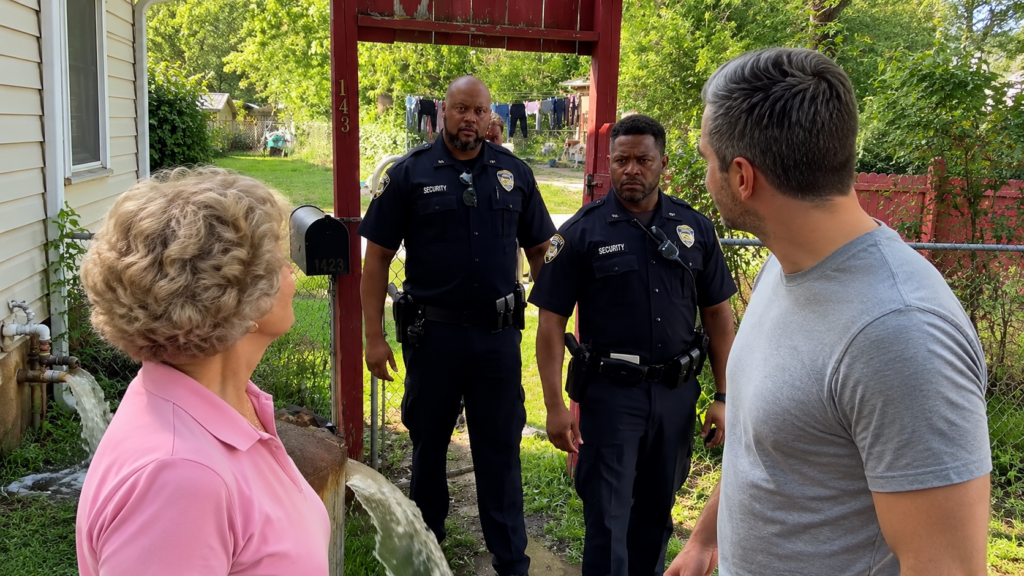
Daniel Reed heard the first crack while he was cutting an apple at his kitchen counter.
The noise came from behind the house, where the old galvanized tank stood between his vegetable beds and the alley fence.
He put down the knife and heard a second impact.
By the time he reached the back steps, his sixty-five-year-old neighbor Carol Mercer had raised a baseball bat for another swing.
The bat struck the tank with a hollow metallic boom.
A dent opened beside its lower seam, and a bright thread of water began running down the wall.
“Carol, what are you doing?” Daniel shouted.
She turned toward him with the bat resting across her shoulder.
“This ugly thing should have been removed months ago.”
“It is on my property.”
“Not according to me.”
Her smile was almost cheerful.
Daniel saw a new crack widening below the latest dent, and he raised his phone.
“You are destroying something you do not own.”
Carol looked directly into the camera.
“Go ahead and film it.”
She hit the tank again.
Daniel kept his distance, although every instinct told him to pull the bat from her hands.
“You really should stop,” he said.
“Or what?”
Two patrol cars turned onto Willow Creek Drive before he could answer.
Carol lowered the bat slightly, then recovered her smile as the officers came through Daniel’s side gate.
One officer was broad-shouldered and young, with the name Alvarez on his badge.
The other was a woman in her forties who carried a small notebook instead of approaching the broken tank immediately.
“Who did this?” Alvarez asked.
Carol pointed at Daniel.
“He has been illegally storing water and flooding my property.”
“She struck the tank four times,” Daniel said.
“I recorded the last two.”
Carol folded her arms.
“Good, then they will see I warned him.”
The woman officer, Sergeant Keene, asked both neighbors to step away from the wet patch.
She noticed that the water was draining toward a gravel channel instead of Carol’s fence.
“Are you saying the tank was leaking before today?” she asked.
“For months,” Carol replied.
“Then why is the ground beneath the older pipe dry?”
Carol opened her mouth, but Alvarez had already moved around to the far side of the cylinder.
He brushed dirt from a small brass plate bolted near the base.
“Is this the original identification tag?” he asked Daniel.
“My grandfather installed it decades ago.”
Alvarez read the stamped numbers again, then turned to Keene.
“This is county equipment.”
Carol interrupted immediately.
“It is a rusty yard tank.”
“It is listed on the county emergency-water plan,” Alvarez said.
“The service line branches to other houses.”
Daniel looked at the pipe disappearing under a bed of rosemary.
He knew his grandfather had maintained a backup supply during winter outages, but he had never understood that anyone else could draw from it.
“Which houses?” he asked.
“We are checking that now,” Keene answered.
Alvarez raised a second question before Carol could leave.
“Mrs. Mercer, why did you tell dispatch you had never seen this tank before when your signature appears on the notice describing it?”
The smile disappeared so quickly that Daniel almost missed the change.
For the first time, Carol looked less angry than trapped.
“That was years ago,” she said.
“It was eleven months ago,” Alvarez replied.
“And the form was an acknowledgment of shared emergency access.”
Carol glanced at the broken seam, then at the officers’ radios.
“I want a lawyer,” she said.
“You can ask for one,” Keene replied.
“For now, put the bat down.”
Daniel watched the bat land in the grass beside the water he had once used to irrigate his grandfather’s peach tree.
It occurred to him that Carol had aimed every blow at the same narrow part of the tank.
That looked less like uncontrolled anger than a person carrying out instructions.
CHAPTER TWO: SEVEN BLUE TAPS
Within forty minutes, a county utility pickup arrived with a folding barrier, a toolbox, and a woman named Mira Solis.
Mira wore a navy field jacket with a faded patch showing a blue water droplet.
She introduced herself as the county’s emergency-supply coordinator and immediately asked who had isolated the lower outlet.
Daniel admitted he had not touched it.
“Good,” she said.
“Nobody should operate a damaged pressurized connection without checking the valves.”
Mira placed cones around the wet ground and took photographs of the seam.
She asked Keene to keep Carol nearby while she examined a junction hidden inside a protective cabinet.
A weathered drawing on the cabinet door showed seven circles connected to a common line.
Each circle carried a number, and one was marked Reed.
“These are seven outdoor emergency taps,” Mira explained.
“They are normally locked off and separated from household plumbing.”
“Why seven?” Daniel asked.
“Because a water-main break twelve years ago stranded this dead-end row for five days.”
The county had built a small, locally maintained reserve system with independently tested water and a hand-accessible distribution manifold.
Daniel’s grandfather had volunteered to host the main tank because his lot was the only one with suitable elevation and a maintenance path.
The reserve was meant to provide limited drinking and hygiene water during a declared interruption, not replace ordinary household supply.
A simple gravitation-fed arrangement delivered the reserve to marked collection points at nearby homes.
Residents still had to receive a county clearance before using it, because stored drinking water required periodic testing.
Mira pointed to a small blue tap near Daniel’s garage.
“Every participating property has one of these.”
Daniel had used that tap only once, to rinse garden tools, and his grandfather had scolded him for it.
At the time, he had thought the older man was being fussy about a garden fixture.
“We should have explained it to the new owners,” Mira said.
“That is part of the problem.”
Daniel looked over at Carol.
“She knew?”
“She attended the briefing last November,” Mira replied.
“She was also listed as the alternate neighborhood contact.”
Carol stared at the gate.
Keene asked whether the loss affected the city’s ordinary water system.
“No,” Mira answered.
“But seven homes rely on this location for their emergency reserve if the normal main becomes unavailable.”
“Is it usable today?” Daniel asked.
“Not until we inspect the tank, confirm the remaining volume, and test water quality.”
Mira bent near the split seam without touching it.
“The damage may be repairable.”
Carol raised her head.
“That thing should be condemned.”
Mira studied her.
“You cannot decide that by hitting it.”
“It is obsolete.”
“Who told you that?”
Carol said nothing.
Keene asked her to accompany an officer to the front driveway while they documented the damage.
Mira then opened a plastic binder from her truck.
Inside was a maintenance calendar and a scheduled inspection for Tuesday morning.
“We are doing a county equipment review next week,” she told Daniel.
“This tank has been placed on a disputed replacement list.”
“Disputed by whom?”
“A private contractor called ReadySpring.
”
Daniel had seen a ReadySpring truck parked near Carol’s driveway twice that month.
Its green lettering promised safe water anywhere, anytime.
“What do they want?” he asked.
“To replace the fixed system with temporary storage bladders and portable delivery trailers.”
“Would that work?”
“Possibly, in some settings,” Mira said.
“But their proposal assumes the present tank is unusable.”
Daniel looked back at the fresh cuts on the metal.
“And now someone has tried to make that assumption come true.”
Mira did not answer immediately.
“That is exactly what I need to find out,” she said.
CHAPTER THREE: THE LETTER UNDER THE MAGNET
Daniel’s sister Nora arrived as the utility crew secured the damaged outlet.
She had been on her way to collect their mother’s old photograph albums when Daniel called.
Instead of greeting him, she stopped beside the garage and stared at the water staining the concrete.
“I thought the tank was indestructible,” she said.
“Apparently a baseball bat disagrees.”
Nora worked as a physical therapist and had little patience for neighborhood disputes.
She nevertheless understood systems of shared responsibility better than Daniel, who repaired antique radios for a living.
“Why would Carol destroy something she helped maintain?” she asked.
“I am trying to work that out.”
They walked into the kitchen while the county crew waited for permission to bring in a tank specialist.
Nora remembered seeing a fluorescent postcard stuck to the refrigerator on her last visit.
She found it beneath a magnet shaped like a peach.
The card advertised a ReadySpring demonstration and said residents could attend a presentation on modernizing emergency-water services.
A handwritten note on the reverse read, Tuesday inspection must not happen with old tank full.
Daniel recognized Carol’s looping handwriting from years of complaint notes left on his doorstep.
“You should give that to Keene,” Nora said.
“It proves she planned this.”
“It shows she wrote about Tuesday,” Daniel replied.
“I do not know who told her to.”
Nora picked up her phone.
“Then find out before someone blames you for the water loss.”
Daniel called the number printed at the bottom of the card.
A receptionist named Audrey answered with polished enthusiasm.
“ReadySpring resilience services, how may I protect your neighborhood today?”
Daniel gave his name and asked who had requested a replacement assessment for Willow Creek Drive.
Audrey paused.
“That is an active county procurement matter.”
“Your employee has been visiting my neighbor, and now my water tank is split open.”
The cheerful tone vanished.
“I need to transfer you to Mr. Vaughn.”
The call clicked twice before a man answered.
“This is Colin Vaughn, regional projects.”
Daniel introduced himself again.
“I understand your company wants to replace our reserve tank.”
“We have proposed a safer modern solution.”
“Was Carol Mercer helping you?”
“I cannot discuss private consultations.”
“She damaged the tank an hour ago.”
Vaughn waited a beat.
“That sounds like a criminal matter, Mr. Reed.”
“It is.”
“Then let law enforcement handle it.”
Daniel heard a muffled voice in the background ask whether the inspection had been canceled.
Vaughn moved away from the receiver.
“I have another meeting,” he said.
“Someone from our office will contact the county.”
He ended the call.
Nora had heard enough on speakerphone to frown.
“He did not ask whether anyone was hurt.”
“He asked nothing at all,” Daniel said.
Outside, the utility crew placed a temporary clamp over the broken seam.
Mira walked into the kitchen with a photograph of the damaged panel and a concern that was more serious than its appearance.
“The lower outlet had been marked for replacement before the assault,” she said.
“Who marked it?” Daniel asked.
“That is what I am trying to establish.”
The mark consisted of three orange paint dots close together.
Daniel remembered seeing identical dots on a ReadySpring display trailer parked outside the library.
He told Mira about the postcard and Vaughn’s reaction.
She asked him to preserve the card and the phone call details.
“A bad bid does not prove sabotage,” she cautioned.
“But a contractor’s preexisting description of damage that happened today would interest procurement investigators.”
Nora walked to the window and saw Carol being driven away by a patrol officer.
Carol did not look toward Daniel’s house.
For once, her refusal to look at him felt more revealing than anything she might have shouted.











