CHAPTER ONE — THE CAMERA
Carol Mercer believed the neighborhood would fall apart if she stopped watching it for one afternoon.
She had the municipal code bookmarked on her kitchen tablet, a measuring tape in her purse, and a notebook filled with the license plates of visitors to Willow Creek Drive.
She had reported a basketball hoop because its backboard extended four inches past a driveway.
She had photographed a teenager unloading groceries because his delivery van occupied a curb for eleven minutes.
When the Henderson twins drew a chalk moon on the sidewalk, Carol poured water over it before their mother could take a picture.
Daniel Reed had tried ignoring her.
He had also tried reasoning with her, which was how he learned that Carol regarded reason as a type of surrender.
On Saturday morning he was replacing a kitchen faucet when something scraped against the garage siding.
Through the window he saw Carol standing on his stepladder, wrenching at the security camera above his driveway.
The camera was the size of a plum, mounted beneath the garage eave and pointed toward Daniel’s own vehicles.
Carol pulled hard enough to crack its plastic base.
Daniel ran out with his hands still wet.
“Get off that ladder before you fall,
” he shouted.
Carol twisted toward him without releasing the camera.
“Take that thing down,” she snapped.
“You’re recording my property.”
“It doesn’t even show your porch.”
“You people always say that.”
She yanked the cable and dropped the device onto the concrete.
Daniel caught the ladder before her next movement knocked it sideways.
“You just destroyed my camera.”
“Then send me a bill,” Carol said.
She climbed down and thrust the torn wire toward him like evidence of a victory.
Her sleeve slipped back, exposing a white shipping label stuck to the inside of her wrist.
Daniel glimpsed the name Marianne Bell and an address on the other side of town.
Carol noticed his gaze and ripped the label away so quickly that adhesive remained on her skin.
For the first time that morning, she looked frightened.
“Whose package is that?” Daniel asked.
“Mind your own business.”
She crossed the strip of grass between their driveways and disappeared into her garage.
Daniel considered following her, but his eight-year-old nephew Finn was coming for lunch, and the shattered camera lay at his feet.
He picked it up and found a memory card still seated inside.
The lens was ruined, but a short clip survived on his laptop.
Carol’s face filled the opening seconds as she reached toward the camera.
Behind her, visible only in the corner of the frame, a white delivery van passed the intersection at 12:38 a.m.
The driver had turned without headlights until the vehicle cleared Carol’s house.
Daniel replayed that detail twice.
He had never thought much about the late vehicles on their quiet street.
People worked odd hours, and Carol seemed capable of complaining about a passing cloud.
Yet he remembered a truck idling outside her place at two in the morning the previous Tuesday.
He remembered hearing metal wheels over pavement after midnight.
He also remembered Carol calling the police when a neighbor’s contractor arrived fifteen minutes before permitted working hours.
A woman obsessed with noise had apparently learned to tolerate a surprising amount of it after dark.
At six that evening Daniel drove Finn home and stopped for groceries.
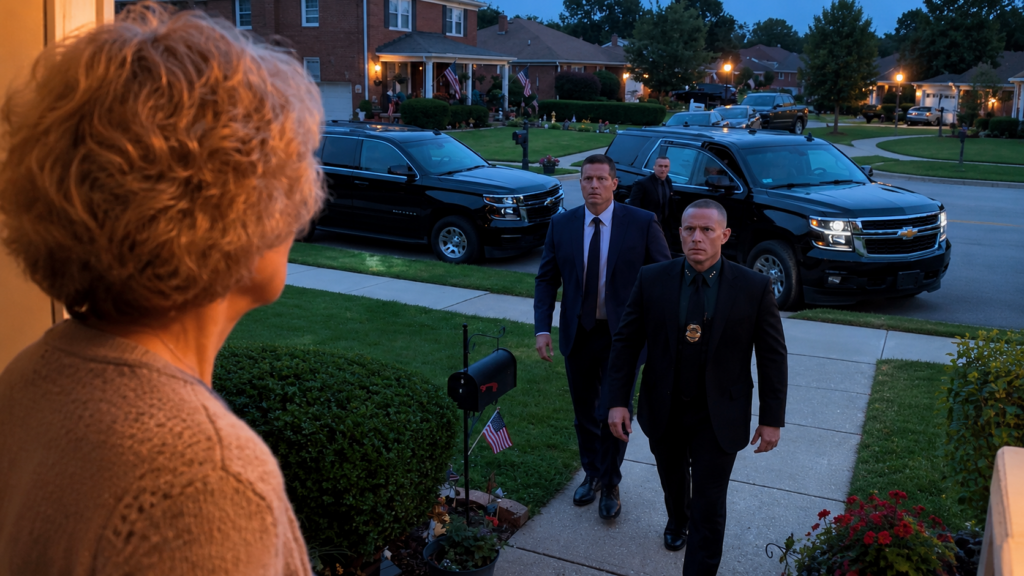
When he returned, two unmarked sport utility vehicles occupied the street outside Carol’s house.
Four people stood on her walkway.
One wore a dark jacket with the letters FBI across the back.
A woman in a gray coat showed Carol an identification wallet.
“Mrs. Mercer, we need to discuss packages delivered under several names,” she said.
Carol immediately attempted to close the front door.
The agent held her ground without stepping inside.
“We are not entering your home,” she said.
“We are asking you to answer some questions.”
Carol looked past the agents toward Daniel.
Her expression carried the same fierce disapproval he knew, but something else moved beneath it.
She seemed to be waiting for a door to open behind him.
“Ask the post office,” she whispered.
“I don’t know anything about those people.”
The agent opened a small notebook.
“Then why did you sign for a shipment addressed to Marianne Bell at one forty-two this morning?”
Carol’s hand flew to the mark left by the label.
Daniel realized she had been destroying his camera because it faced the driveway where the midnight van turned.
What the camera might have recorded was no longer the most interesting question.
He wanted to know why a woman who monitored every stranger on Willow Creek Drive had been receiving strangers in darkness herself.
CHAPTER TWO — THE WOMAN ON THE LABEL
The agents remained outside Carol’s house for twenty minutes.
Daniel watched them leave without an arrest or a search.
One of them crossed the street before entering the second vehicle.
She introduced herself as Special Agent Lena Ortiz and displayed identification without being asked.
“Did you see what happened to your camera this morning?” she asked.
“I was there when she tore it down.
”
“Have you kept the damaged unit?”
“Yes.”
“Please don’t erase anything or confront her about our visit.”
Daniel studied her cautious expression.
“Is somebody in danger?”
“We’re trying to locate property that belongs with several families,” Ortiz replied.
“That is what I can tell you tonight.”
She gave him a card and returned to her vehicle.
After dinner Daniel searched the name he had seen on Carol’s wrist, expecting little.
Marianne Bell lived in a town forty minutes away.
Her photograph appeared in an article from a regional newspaper about a church choir’s memorial service.
The article described her husband,
Peter, a school custodian who had died the previous winter.
The last paragraph said that Marianne was still waiting for a handcrafted remembrance box she had commissioned through a company called Everlasting Passage.
Daniel had heard of the company from its television advertisements.
Its commercials showed polished wooden shelves, smiling families, and carefully lit memorial keepsakes.
One commercial promised that personal objects and commemorative artwork could be returned safely to loved ones anywhere in the country.
The company’s founder, Gideon Shaw, spoke with the soothing patience of a man selling warm blankets.
Daniel looked again at Marianne’s photograph.
He had no reason to involve her in a fight with his neighbor,
but her name had been carried into Carol’s garage after midnight.
He wrote a brief message through the newspaper’s contact form and asked the reporter to forward his phone number.
Then he slept badly.
At seven Sunday morning, a compact sedan parked outside his house.
A woman around fifty stepped out holding a bakery bag and wearing an expression of determined embarrassment.
“Are you Daniel Reed?” she asked.
“I’m Marianne Bell.”
Daniel invited her onto the porch.
She declined coffee and sat where she could see Carol’s driveway.
“My daughter told me not to come,” Marianne said.
“She thinks I’ve spent enough time chasing a wooden box.
”
The box had been designed for Peter by his seventh-grade woodworking class years before he retired.
Each student had carved a small square with a word describing him.
They had assembled the squares around a brass bell from his school.
Peter had kept it on the mantel, and Marianne had arranged to have it repaired after a moving accident.
Everlasting Passage offered specialty restoration and nationwide insured transportation.
The company had collected it in February.
Then the updates stopped.
Marianne called every two weeks.
Representatives told her the box was being processed in a regional studio, that it was delayed by humidity testing,
and that a courier would contact her soon.
A month ago she had received a photograph of a box that was plainly not hers.
“They told me the picture was illustrative,” she said.
“What does that even mean when it’s my husband’s things?”
Daniel described the label on Carol’s wrist.
Marianne’s eyes filled, but she held steady.
“They said it was coming home,” she whispered.
“I never gave them permission to deliver it here.”
Daniel told her what Agent Ortiz had said.
Marianne considered this, then pulled out her phone.
She showed him a photograph of Peter laughing with a classroom full of children, the wooden box raised above his head.
“I know it sounds silly,” she said.
“I can remember him without a box.”
“It doesn’t sound silly,” Daniel answered.
“But it isn’t just memory,” Marianne said.
“Those children made something for him.”
“I promised I’d take care of it.”
Across the street Carol’s garage door rose six inches and stopped.
Daniel saw the toe of a brown shoe beneath it.
The door closed again.
Marianne stood immediately.
“She’s in there.”
“Please don’t go over,” Daniel said.
“The agents were clear about that.”
Marianne sat down with obvious effort.
“I have waited eight months.”
“I can wait another hour if an hour actually changes something.”
Daniel called Ortiz and left a message.
Twenty minutes later the agent called back.
She asked Marianne to come to a field office that afternoon and instructed Daniel to preserve his camera footage.
As Marianne left, Carol appeared in her doorway.
Her arms were crossed, but she watched Marianne’s car with a terrible concentration.
Daniel understood that Carol had recognized the visitor.
He also understood that she had no intention of admitting it.











