Chapter 1: The Woman on the Ladder
The first blow cracked the plastic housing around my porch camera, and I heard it from the upstairs bathroom.
The second blow shook the wooden bracket above my garage door.
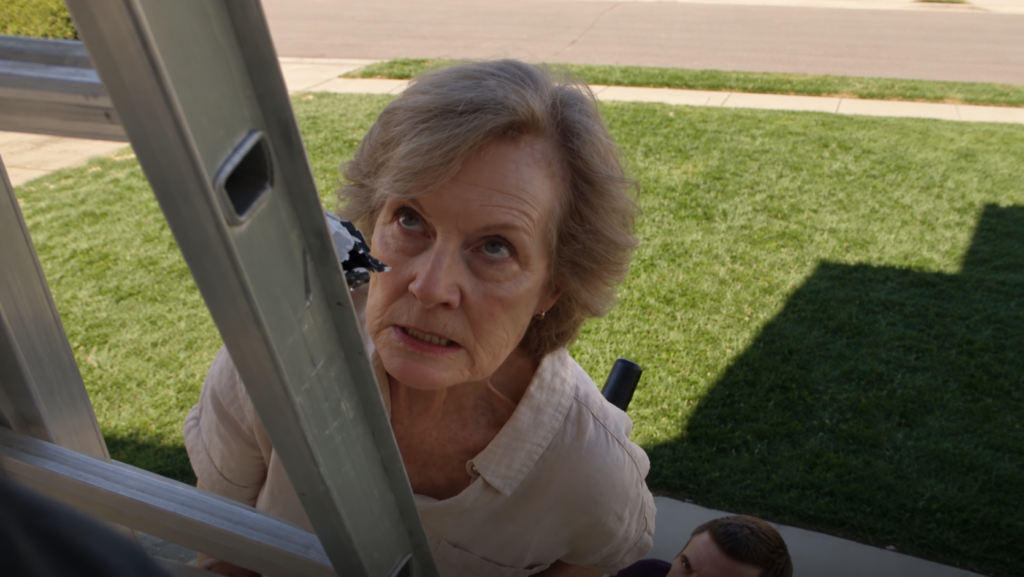
By the time I reached the kitchen, my neighbor was balanced near the top of a silver extension ladder with a hammer in her right hand.
Her name was Vivian Rourke, and until that Saturday morning, I had never seen her do anything more physical than point at other people’s lawns.
She was sixty-three, wore pressed white tennis clothes even when she was not playing tennis,
and chaired the architectural committee of our neighborhood association.
Now her hair was loose around her face, and her left shoe had slipped halfway off a ladder rung.
I pushed open the side door and shouted her name.
Vivian swung again without looking at me.
The camera broke free, struck the driveway, and scattered fragments over the concrete.
She climbed down too quickly, nearly losing her balance on the last two steps.
I moved toward her, but she pointed the hammer at the ground between us.
“You had no right to put that camera there,” she said.
“You just destroyed my property,
” I answered.
“That camera was watching my house.”
I looked over my shoulder at the empty driveway that separated our homes.
My camera had been aimed at my garage, the front gate, and the narrow walkway where packages kept disappearing.
A little of Vivian’s side fence appeared at the extreme edge of the frame, but her windows did not.
“It was watching my driveway,” I said.
“I know what it saw.”
The certainty in her voice caught my attention more than the hammer.
“What did it see, Vivian?”
She opened her mouth, then looked toward her own garage.
A curtain moved in the upstairs window.
Vivian lowered the hammer and pulled a folded paper from her pocket.
“Take it down permanently, or you’ll hear from our attorney.”
“You already took it down.”
She dropped the paper at my feet and walked away with the ladder scraping against her shoulder.
I picked up the notice after she crossed the property line.
It was not on association letterhead, and there was no attorney’s name anywhere on it.
It was a printout of a neighborhood policy that had expired four years earlier.
I might have been angry enough to call the police immediately if the camera had been the only thing she damaged.
Instead, I noticed a narrow scratch on my garage door beneath the mounting bracket.
Someone had carved three letters into the paint during the night.
They were small, crooked, and almost invisible unless the light hit them sideways.
The letters were E, L, and I.
My younger brother’s name was Eli.
He had been missing for eleven years.
Chapter 2: The Last Place He Was Seen
My name is Nora Mercer, and I returned to Bellhaven, Pennsylvania, after my father died in March.
He left me the cedar-sided house on Wren Court, a pile of medical bills, and a garage full of tools he had cleaned every Sunday while refusing to clean his own kitchen.
My father had been a school bus mechanic, and he believed any machine could be understood if a person listened long enough.
I was thirty-eight, divorced, and working remotely for a regional medical supply company when I moved back.
For years, I had avoided Bellhaven because every street contained a version of the same question.
What happened to Eli Mercer?
He had been seventeen when he vanished after a summer party at a house beside the old railway cutting.
People said he ran away to Philadelphia, joined a band, or caught a bus toward the ocean.
Nobody could explain why he left his guitar,
his wallet, and the little dog he had adored.
My father spent a decade collecting rumors until grief made him suspicious of every stranger.
I hated how his searching consumed him, but I never believed Eli left voluntarily.
The morning Vivian broke the camera, I had no idea how close my father had come to learning the truth.
I only knew that the initials on my door were fresh.
I photographed the damage and called Bellhaven police.
Officer Daniel Reed arrived fifteen minutes later and examined the broken camera beside the garage.
He was younger than me, with careful eyes and a habit of repeating dates before writing them down.
Vivian came out of her house as soon as she saw the patrol car.
“This is an association matter,” she announced from her porch.
Reed asked her to come closer without bringing the hammer.
She gave him a look that suggested she had never been told where to stand by anyone in uniform.
“It was filming private activity,” she said.
“What private activity?” Reed asked.
Vivian glanced at me and adjusted the sleeve of her shirt.
“People have the right to enjoy their homes.”
Reed examined the surviving camera bracket and asked where its recordings were stored.
“In an online account,
” I said.
“Do you still have the recording?”
I had not checked because the camera had gone offline during the attack.
Reed suggested that I preserve everything available before anyone changed the device settings.
Vivian stepped forward so sharply that he moved one hand toward his belt.
“That recording is illegal,” she said.
Reed told her the question of legality would not be settled by breaking equipment.
He took statements, photographed the ladder leaning against her fence, and issued her a notice concerning criminal mischief.
Vivian did not argue about the hammer again.
She wanted to know whether he would take my recording as evidence.
Reed said he might.
For the first time that morning, Vivian looked afraid.
Chapter 3: Eighty-Seven Seconds
My camera service kept the last thirty days of motion clips, and the damaged device had uploaded its final recording before losing power.
I sat at my father’s kitchen table and opened the app while Officer Reed waited across from me.
The first clip showed a delivery truck leaving at 6:12 the previous evening.
The next showed my empty driveway at 9:43.
Then came a clip from 2:16 in the morning.
A dark sedan rolled slowly past the house and stopped beyond the reach of the porch light.
A person wearing a hooded sweatshirt approached my garage from the neighbor’s side of the driveway.
The hood hid the person’s face, but something pale swung from the right wrist.
The stranger touched the garage door for several seconds.
When the figure stepped back, the initials had appeared beneath the camera.
“Pause it,” Reed said.
I froze the image as the person raised one arm.
A narrow bracelet caught the light.
It had a small silver charm shaped like a bird.
My stomach tightened.
Eli had given that exact charm to his girlfriend, Hannah Price, for her seventeenth birthday.
Hannah was now married,
living two towns away, and raising twins.
I had seen pictures of her bracelet once in an old family album.
“Someone wants me to think about Eli,” I said.
Reed asked me not to jump to a conclusion about who wore the bracelet.
He played the clip again.
At the edge of the image, behind Vivian’s fence, a second person stood beside a parked vehicle.
The second person did not approach my property.
But when the hooded visitor returned, the car’s passenger door opened from inside.
“There are two people,” Reed said.
The clip ended as the sedan drove away.
Another recording began at 5:58 in the morning.
Vivian stepped from her garage carrying her ladder.
She looked at my camera before placing the ladder beneath it.
Then she looked toward the street, apparently waiting for a vehicle to pass.
Reed watched without comment as she climbed and lifted the hammer.
The sound of her first strike came through the laptop speakers.
My hands shook, but not because of the vandalism.
I was staring at the lower corner of the video.
Just before Vivian swung, somebody inside her upstairs window had held a sheet of white paper against the glass.
Three black words appeared on it.
PLEASE DON’T STOP.
Chapter 4: The Window
Reed watched the final frame twice before saying anything.
The lettering was large and uneven, written with a thick marker on ordinary printer paper.
The paper vanished when Vivian struck the camera.
“Who lives with your neighbor?” he asked.
Vivian’s husband, Malcolm, had died seven years earlier, and most people believed she lived alone.
But I had noticed a young woman arriving in a gray station wagon three evenings earlier.
She carried grocery bags through the side gate and had not come out again.
“Maybe a relative,” I said.
Reed asked whether I had seen her leave.
I had not.
He walked over to Vivian’s house while I remained behind my kitchen window.
She opened the door only a few inches.
Their conversation lasted less than a minute.
Then the door closed, and Reed returned.
“She says her niece is staying temporarily,” he told me.
“Does her niece want help?”
“Vivian says the young woman is recovering from an illness and doesn’t want visitors.”
I pointed toward the upstairs window.
“Then who wrote the sign?”
Reed studied the house and made a call from his car.
He said another officer would join him for a welfare check.
Before his colleague arrived, Vivian’s garage door opened.
A white utility van backed into the driveway and stopped with its rear doors facing the house.
A broad-shouldered man stepped out wearing a faded jacket with the name of a local restoration company stitched above the pocket.
I recognized him immediately.
Calvin Sloane had been one of Eli’s closest friends.
He had testified that he last saw my brother walking away from the railway party alone.
Calvin looked toward my house, saw the police car, and stopped moving.
Vivian came outside and spoke to him urgently.
He started back toward the van.
Reed walked across the driveway and called him by name.
Calvin turned slowly, with the expression of a man being asked a question whose answer he had practiced for years.
“Are you here to visit Ms. Rourke?” Reed asked.
Calvin said he was replacing a damaged basement door.
Reed asked where the new door was.
Calvin glanced at the empty cargo area visible through the van windows.
“I haven’t picked it up yet.”
The answer made no sense.
Then another officer arrived, and Vivian’s hand tightened around the porch railing.
The woman upstairs appeared behind the curtain for one second.
I saw part of her face before someone pulled her back into the room.
She looked like Hannah Price.











