The first sentence of the letter said that the woman in the photograph had saved my life before I was old enough to remember her face.
I read those words three times while the breakfast crowd continued talking around me.
The photograph showed a young woman standing outside a brick hospital with a little girl wrapped in a yellow blanket.
The woman had my dark hair and the same uneven smile I saw whenever I looked in a mirror.
I knew her name before I turned the photograph over.
My mother had been dead for nineteen years, and I had never seen that picture.
The man in the work jacket watched my hands begin to shake.
His name was Daniel Whitcomb, and he said his father was waiting at home for an answer.
I asked him what kind of answer an injured stranger could possibly want from me.
Daniel looked toward the kitchen, where my supervisor was already pointing angrily at the unfinished coffee orders.
He told me that his father had recognized my name on the badge pinned to my apron.
I said that Bennett was hardly an unusual name.
Daniel answered that his father had recognized my face first.
The noise of the cafe seemed to pull away from me.
I asked him to tell me exactly what the letter meant.
He said the rest belonged to his father, but that I deserved to hear it somewhere private.
My supervisor, Calvin Price, came around the counter before I could reply.
Calvin told Daniel that personal conversations were not permitted during the breakfast rush.
Daniel apologized politely and offered to wait until my shift ended.
Calvin told him that waiting customers were required to buy something.
Daniel ordered coffee he clearly did not want and took the corner table beside the window.
I carried his cup over with hands that no longer felt steady.
He thanked me and placed a business card beneath the saucer.
The card identified him as the owner of a small construction company in the next county.
He said his father had broken his arm while repairing a porch railing at an old family property.
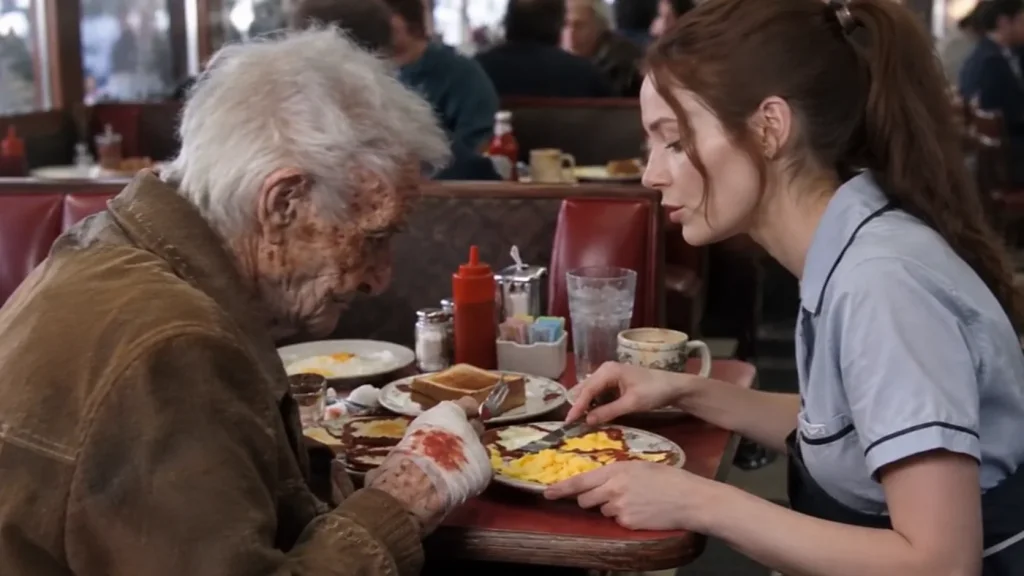
I remembered the elderly man struggling to cut his pancakes, and the ordinary tenderness of that moment suddenly frightened me.
Daniel told me that his father had spent the previous evening asking whether I would believe him.
I asked why belief mattered so much.
Daniel said his father had kept a promise for almost twenty years, and the promise had become harder to carry with every passing season.
I folded the letter and slipped it into my apron pocket.
I spent the next four hours delivering plates while my mind returned to a hospital I could barely remember.











